Wednesday, August 7, 2013

My Game, My Color

The last post I wrote challenged some preconceptions about the Pro Tour Hall of Fame ballot process.   I still have an idea rummaging around in my brain pan about challenging another major preconception, but it's still in its infancy.  Until I figure out how to express this new idea, I'm going to take a personal look at my own personal beliefs about Magic, the color pie, and my place in it.

As a Gamer I Am Mostly...
...boring.   I'm 40 years of age, but this isn't something that has happened recently due to my descent into decrepitude.   I've been playing games my whole life.   A good portion of that was spent playing video games, starting as early as the now legendary Atari 2600.   I looked for games that had depth and allowed me to choose my own fate.  In any situation I could choose how I played, from Dungeons and Dragons role playing to Mass Effect, I was inexorably drawn towards playing characters in a very narrow way.   Blame it on a million different factors, but if I could be Lawful Good (or some derivation thereof), I would be a shining example for the eons.

So as a video gamer if we were to apply Magic's color wheel to my gameplay philosophy, you would think I would be described as a player who preferred white.   Very white.   Historically, I was drawn towards games that allowed me to make decisions that were altruistic.   I wanted to impose order.  I felt a strong pull towards helping other players.   I never enjoyed playing as a Cleric, but playing as a Paladin or a helpful thief with a conscious was always possible.   I was the guy that could tell you how every game with more than one path to completion ended - so long as it was the only path that was possible if I made morally 'good' choices.    Even playing Grand Theft Auto, I was the good guy.  Don't think for a moment that I didn't try to occasionally shrug off my mantle of righteousness to get to the alternate ending of a role-playing game.   I would start off with the evilest of intentions.   It would all be for naught.   I'd get two or three days into a game and suddenly find myself rescuing the maiden or solving the villagers' problems, instead of creating the ruin I set out to do.   Mayhem was not my middle name.   Actually, it was probably more like Fred.   'Fred the Paladin' has a ring to it, doesn't it?

But where does that need to be the high and mighty gamer come from?

In Real Life, I'm...
...the same, boring personality.   I follow the rules.   Actually, that's not completely true as I do have a problem with posted speed limits.   I prefer to think of them as guidelines.   I'm not here though to defend my medical condition of Plumbum Pedis.

Where were we?   Ah yes, my penchant for following rules.   At work, I deal constantly with people that want me to bend rules, just this 'one' time.   But that, my friends, is the path to chaos.   Break the rules once?   Not on my watch.   Co-workers think it's cute (actually, they think I'm downright annoying at times), but I'm over what people think.   My kids think I only look at life in terms of black and white.   People who really know me realize that I have a small streak of bad in me.   Something that lets me have fun - but ONLY when it's the right time and the right place.

I won't go too much into my personal life.   It would put most readers to sleep.   What is important from this trip down the rabbit hole of Magic Dad's psyche is that we realize that in my personal life, I'd align more than VERY WHITE with the Magic Color Pie.   I'm actually 100% white - to the point that lands other than plains would never touch my hands.   Artifacts would be banished from my sight.   In fact, I don't know if I would suffer players of other colors sitting at the same table, nay, in the same room as me.

But, in Magic the Gathering...
...I identify with another color.   To find the way to who I am, I have to talk a little bit first about what I'm not.

How have I bucked 40 years of gameplay tradition you ask?   The answer may be less about being able to derail years of environmental and genetic inputs, and more about really understanding the classification of colors in Magic.   Let's first look at the color pie and what it lets us do.   I'm going to borrow heavily from the guru of Color Pie wisdom, Mark Rosewater (any mistakes are mine) as I talk about the colors of Magic.

White - Let's deal with the elephant in the room.   I don't align strongly with White.    White does stand for altruism (check).   It stands for following the rules and getting others to follow the rules for the good of the collective (check).   It seeks to share resources (check).   It does seem to do many of the things that I enjoy from other games.   So why isn't it right for me?   Most every player identifies more with one color than any other.   Even if they don't claim to, certainly they favor a color over others.

White does have a certain affinity for me.   I enjoy playing it as a second color.   My only Commander deck is Boros (Red/White).   That's more from lack of resources though than for any other reason.   It's the closest I could get to a red deck with what cards are at my disposal.   White is also rarely my first pick as a color in limited, even when presented with a bomb.   There is another color in Magic that identify with in a much stronger, more visceral manner.

Black - I'm sure you realize that as black is the polar opposite of white, it's rarely a color I want to be playing.   Certainly, black has an allure that I find tantalizing.   Creatures and spells that look to create some chaos on the board in the form of Deathtouch and tricks with the graveyard can be fun to play.   I'm not altogether comfortable playing Black though.   It's more than the association with Zombies, graveyards and Demons that makes me uncomfortable.

Black is chaotic.   I've never piloted it without having some personally unexpected results.   My favorite being when I forget for the millionth time that Deathtouch doesn't beat First Strike.   Ah, Deathtouch.   I don't think there is any creature ability that fills players with such trepidation.   Do I attack?   When do I attack?   Do I hold?   What is the most likely result from going on the offensive?   A single creature with Deathtouch on the board forces both players to evaluate, then re-evaluate every attack.   It can be very painful when it's misplayed.   Chaos indeed.

Blue - I think I'm least comfortable with Blue.   I appreciate much of what it stands for - thoughtful planning and measured outcomes.   I enjoy playing a mid to large size blue flyer as much as the next guy.   Yet when it's time to plan out 3 steps in advance (including opponent responses) to optimize my uses of Cancel and Negate, I often just phase out.   I find it difficult to remain interested in the planning process required to pilot blue decks.

I want to be more Blue.   I know this is the color that pros and power players drift towards (so long as the format supports it), but my comfort with being in control to the point that I can pilot my deck while denying the right components of my opponent's deck isn't there yet.   Perhaps in time, I'll figure out how to make Blue work for me.

Green - I love green.   Perhaps it is a result of my formative years watching Sesame Street and becoming entranced with Oscar.   It could also be that I associate it with my love for nature.   Or perhaps, I just like making things big and smashing face.   Green is almost exclusively about growth.   Tokens, counters and buffs that make opponents stare holes into their hand looking for answers is what Green reminds me of when I play it.   And let us not forget the fat creatures that get bigger and bigger with the right support.

If I had to choose between White and Green, I'd pick Green (it is close though and largely depends on the format).   I appreciate the ability to simply wade in and do damage.   It also seems rather neutral to me in terms of alignment, a little bit of, "I don't care what you think," is happening with Green players.   In the end though, it isn't my preferred color.   That honor goes to the last color I want to talk about.

Red - Red runs contrary to almost everything I told you about myself as a gamer.   So why Red?

Let's go back a moment and look at something important I said earlier.   I told you that I couldn't stand being the cleric, but I loved being the Paladin.   The logic behind that statement is that I simple enjoy doing damage.    I don't need it to be clever (like Blue), nor do I want it to be sacrificial (like Black).   I want to be strong enough for it to hurt (unlike White).   And I want to do it fast (unlike some of Green).   Give me a 2/2 with haste, and I'm happy.   Better yet, give me a 4/2 with haste and I'm in heaven.   Red is about being aggressive and punishing the player across from you.   The question shouldn't be why do I enjoy playing Red.   Rather, it should be why doesn't everyone?

Red is emotional for many who play it.   For me though, it has become less about my emotion than it is about my opponents.   From what I can gather, many players really don't like running up against a mono-red deck.   They almost tilt from the first play, giving me an advantage.   Mono-red is not always the strongest deck in a format - but it doesn't have to be when you take into account how others react to it being played.

This is only a part of the story.   I'm sure, having read this far, that you're still wondering how I came to align as a red player.   There is one critical part of my gaming pedigree that I kept from you.

Hit'm Hard
When I play computer games, notably single player games, I do play as a white knight.   But when I play social games, whether they are computer, card, or board games, I have a slightly different personality.   I have no problem selling out my neighbor.   I don't care if I rob Peter to pay Paul, so long as it messes up Mark's next turn.

Here is one little story to help you understand best why I'm red.   Four years ago, I was taking a comprehensive training course.   One night of the course, the fifty of us enrolled engaged in a game set up by the instructors.   The game was unlike anything we had ever played.   The premise of the game was simple.   Teams of five to six players are formed and you worked with your team to make a simple decision each turn over a course of 10 turns.   If one team selects X and the others select Y, then the team that picked X receives all of the points and the teams that pick Y receives negative points.   If two teams pick X then they split the points and the Y teams get negative points.   But, if all teams picked Y, then they would equally split a small amount of positive points.  On the chance that all the teams in a pod selected X, then they would all receive negative points.   The stakes increase as the game progresses and the rules change to encourage greater collusion between teams.   Teams that realize early one that working together has a consistent, flat pay out do alright.   Teams that figure out screwing over everyone around them is the only way to really come out ahead CAN do better - but at a cost.

Turns 1-3, the teams in my pod worked independently of each other.   We were in a pod with three other teams, and our decisions were weighed against the other teams.   We always made the choice to maximize personal value by choosing X, but this penalized other teams in my pod who were slow to catch on to the concept.   By the third turn, the other teams on my side of the room had figured out how the game worked and had started to encroach on our strategy, negating further advancement in points.   Then the rules changed.

We were to send one representative from each pod to discuss the next decision.   Point values would be doubled.   For the next three turns, all of the teams in my pod agreed to work together.   Slowly, each team in my pod advanced on the scoreboard.

Then the rules changed again.   At the start of turn seven, point values would be 5 times what they were before.   Now remember that if we worked together, we would all advance.   But if one team betrayed the others, they would reap tremendous points if they could pick the right time to do it.

For turn seven, our team worked with the others in our pod.   But while our rep was sent to the conference before turn eight, I turned to my other teammates and looked at them and said, "We're going to win this.   Are you ready?"  I still don't think even my own teammates at that point really understood the game.   But I could see it.   In fact, I saw it back at the start of round four.  I realized then that we'd be allowed to meet together for the rest of the game and the game would increase in bonus multipliers at least one more time.

By turn nine, everyone would be salivating at the chance for big points.   Teams would betray one another.   I figured it was highly likely that half the teams in my pod would turn on the other half.   By acting in turn eight, my team would have the advantage.

The call went out, and we made our decision known.   We gained a ridiculous amount of points, while the other teams in our pod went down in flames.

We were yelled at.   A lot.   One of the other teams were practically screaming at us.   To this day, there are one or two people on the opposing teams that won't talk to me (truth is, they also left the organization immediately following that weekend - but they weren't exactly mentally stable to begin with).   I tilted half a room of grown adults.   In a room with half the adults yelling, most of them at me, I sat there and smiled.

We played by the rules.   No rule said we had to abide by the agreement of the other teams.   In fact, it works better if you don't.   It's not unlike Magic.   There is known information in the game, but there is also hidden information, that may only be known to one player.   If that one player can use the information fairly and to his or her advantage, should they not act upon it?

FULL DISCLOSURE - The ultimate purpose of the game in the setting when we played it was to do one of two things.   It was either to provide that perfect moment where everyone gets upset, realizes how silly they all are and then provides a point to reset their teams and move forward as one OR it was to provide a total team building experience.   I took the low road - but I was tired at that point and was analyzing the game for the sake of figuring out how to break it.   I'm told this is one measure of how staff are selected for future courses (and yes, I was invited back to be on staff after 'breaking' the game).   I also have anecdotal evidence of this game ending in fist fights.  It's amazing how seriously people take things sometimes.  Also, as a rule adults are more altruistic as a group than youth are when this game is played.   Most youth get to a point very early on where they don't care about working together, they'll all go down with the ship to try to get one chance to make a big gain in points.

Conclusion
And that, my friends, is why I'm red.   I like to win, and to do so in a way that sows a small amount of discord at the same time.   If you tilt, it's not my fault.   You need to realize that tilting is purely a personal issue, and controlling your reaction to a game is something only you can have power over.   It doesn't help when you feel betrayed.   That is an emotion.   In the equation of the game, emotion is your enemy.

Magic is a social game.   Too many of us forget what that really means though.   It doesn't exclusively refer to the fact that we play it with other people and have a chance for conversation.   The full definition of Magic as a social game means that emotions, body language, and a certain amount of sleight of hand (figuratively, not literally) are important components to playing the game.   Those that understand this best are the players that will go the furthest.   Those that think it only means we come together to talk about the coolest cards in the new set will be stuck in the middle of the pack.   I know where I would rather be...do you?

____________________________________


Reblogs & Retweets & Mentions of all kinds are appreciated - as an independent writer I'm only read when others like what they see and share with their friends.   Even better for this story, leave me some feedback about why you identify with a particular color.   I'd love to hear about your opinion.

Wednesday, July 24, 2013

My Hall of Fame Vote

I'm really excited to be picking some players for this year's Hall of Fame.   My first and easiest selection was of course, Chris Pikula.   I do understand that most everyone's first pick was the great LSV, but I go for the altruistic vote first - and in this case Chris has it in spades.   Oops, I guess I spoiled my second vote, it's none other than LSV.   His play is almost as good as his legendary puns.   When you think of limited, if his name as a Pro Player isn't the very first you think of, well, you're not in touch with the community.

My third pick has to be... {KNOCK, KNOCK}.

Sorry, let me get that, I'll be right back...

Oh.   Oh my.   It appears there has been a mistake.   I don't get a chance to send in a ballot this year, there's been a horrible misunderstanding on my part.   Aside from the fact that voting has closed, there's another little detail.   Only a few people in the Magic community are allowed to vote.   In fact, I probably won't ever be eligible to vote on this topic.   If writers for major support websites that have five years or more in service don't get a vote and people like Nathan Holt aren't asked to be a part of the selection committee, the chances of me participating are about 1,000,000 to 1.   (I stopped at a million because I didn't want to bore you with zeros - nothing is more boring than zeros).

So why write an article about my picks?  Or what they would be?   Better yet, why should I spend one second of my time as a player reading the seemingly endless array of articles by those on the committee defending their votes?   Seems like utter non-sense to me.

Let's back up for a second.   Surely there is some logic behind the current system.   I'm too new to know all of the reasoning behind the vaunted HoF selection process.   I'm obviously too wet-behind-the-ears to appreciate the nuance of selecting a candidate to vote for from the tremendous field of eligible and esteemed Magic personae.   **POP**   I've just removed the tongue from my cheek.   I'll be good from here on in, because I think there is still a worthwhile discussion to be had here about the current process and how it may (emphasis on MAY) be changed for the better.

Ground Rules
I'm going to debate two sides to this argument.   You'll see them both.   I'll only use what I've learned in the past few weeks along with my own opinions.   I am going to try to convince you, using both voices, that the opinion being expressed at the time is the only opinion worth considering.   To make it sporting, I'll take the voice of someone who wishes to maintain the current system.   Then, after you've read both arguments I want you to think about them.   If one of them hits you particularly hard, I encourage you to comment about it.   Use any method available to you - but know that Twitter seems to be the place that professional Magic players hang out and ultimately they are the ones that may have the most to say about changing the system.

Your ONE job is to look at both sides as objectively as possible.   You don't have to comment.   But I want you to try to look at both arguments with a blank slate.   In the end, you may be surprised by which side makes you feel more interested.

Support the Current System - Down with Change!
*Ahem*

Is this thing on?

Ah, it is.   Well then allow us to proceed.

There is one thing you need to know before we begin.   In fact, this one thing outweighs nearly all other considerations and arguments to be presented.   It is so important, I could simply close when I'm done saying it.   Ready?   It's not the Magic Hall of Fame.   It's not the Magic the Gathering People's Choice Hall of Fame.   The official name of this is the Pro Tour Hall of Fame.   Let's let that sink in, shall we?   The Pro Tour Hall of Fame.   Pro Tourrrrr.   It's not the Tom, Dick and Harry Hall of Fame.   This is for the elite players of the game.   Those who have repeatedly proven themselves as spell slingers of the highest ability.   Why on earth should we need to expand the voting to include everyone?

I can stop here, and my argument for not changing the current voting system would be safe from the drivel that is to follow.   Pro players around the world would give me a nod, or a golf clap and feel that the system would stand up to any further inspection.   They're right.   But let's look at this from another point of view.

Pro players and other members of the selection committee (including those who have had something to do with the Pro Tour in one capacity or another over a period of time) all have one advantage over the rest of us.   Actually I think it's two distinct advantages, but we'll treat it as one for the sake of brevity.   They know the candidates.   Brian Kibler, one of the many members of this year's selection committee actually knows and has played against a number of the eligible candidates.   Sheldon Menery has spoken to candidates either in a coverage capacity or as a Judge.   Mark Rosewater...well, we get the idea.   These people know more about the candidates for this year than we do.   The know whether or not this person shares their knowledge.   They know what kind of player this person was in the 90's.   They know whether or not this person has spent their time and efforts supporting the game and to what extent.   In short, Pro Players and those that interact with them know Pro Players best.

Truth is, this system has worked rather well.   Players are judged in areas that matter beyond their lifetime Pro Points.   Integrity, Sportsmanship and Contributions to the Game are all considered and weighed.   There is no need nor desire by anyone to change this existing system.

You're still not convinced?   Then let's try this argument.   Any other system would be needlessly complex.   How on earth can we open up voting to everyone who plays Magic?   What bloody safeguards would be needed to make certain some knucklehead IT guy doesn't send in 300 votes for someone who's integrity is questionable at best and who never spent day one advancing the game?   It'd be chaos, and I for one would not support it.   A limited voting pool is obviously the only clear choice.

And now, we'll give my opposition a chance to speak...

Burn this Sacred Cow - Let's Change the HoF System!
Now that evil Magic Dad has spoken, it's my turn.   I'm going to ask one question first.   Why, for the love of all things holy, do so many pros write articles justifying their vote or talking about the process when only approximately 250 people can vote?   That's less than 1% of Magic players out there.   Heck, it's probably 1% of 1%.   It's like dangling a 14-ounce steak before a mob of toothless carnivores.   They know they want it.   They can practically taste it.   But they have no means of actually eating said steak.  Their only means of interacting with such a juicy morsel is visually and on the whole, completely unsatisfactory.

Let me say it again.   The current process is unsatisfactory to the thousands upon thousands of gamers who watch the process in intimate detail but have no ability to interact with it.   It may not be in danger of failing yet.   But it surely isn't very satisfactory in it's current form to many players.

Over the past few years, I'm led to understand that the Pro Player system has greatly evolved.   It has done so apparently to create a marketable entity.   Wizards treats the system as a means to drive business in a positive fashion (as they should).   Magic players the world over have started to identify more with particular Pro players.   I'd like to think that I personally identify with players like LSV and Kibler.   Their individual play styles speak to me, as I'm sure Eric Froehlich and Brad Nelson speaks to other players.   This is a byproduct of the current Pro Tour.   Elevating particular players to a status where we appreciate who they are and then we as players move to emulate them.   They, whether they want to be are not, are being elevated to the level of rock stars.

That helps Wizards.   Because to emulate our favorite Pros, we have to purchase product.   We have to invest time in Grand Prix events.   We want to win everything from FNM to *GASP* a seat on the Pro Tour of our very own.   We end up spending more, which in turn helps to sustain the Pro Tour system up to and including the Hall of Fame.

But when it comes to the HoF, our participation stops.   We feel the bitter disappointment that we can't participate further in the journey of our favorites.   We no longer have a stake in the game.   We watch as discussions rage and Twitter erupts for over two weeks on the topic, but have no real say in the matter.

We could get better at the game.   We could spend weeks and years of our lives in pursuit of something that may or, more likely, may not happen.   Or, Wizards could find a way to allow us to participate in the final step of a Pro Player's career.

This year, we may see a slate of HoF candidates enshrined that are all Americans (for a host of reasons up to and including it may be that they are the best options of the available candidates).   Would a popular vote of some kind change this dynamic?   And would that be the worst thing that could come of this change?

I propose that it's not hard to come up with a situation that engages Magic players the world over in one final step of the journey.   And it could be eminently fair to everyone.   It would take two steps.   First, give the current selection committee a weighted percentage of the overall vote - their experience does matter.   Perhaps 80% would be fair to everyone.   Then, allow for 20% of the weighted vote to come from you, the gamer.   To make this as fair as possible only allow us to vote for 3 candidates total (not the 5 allowed the selection committee) AND only allow voting through our Planeswalker account.   Votes could be tracked and limited this way to no more than one per person.   Any shenanigans that are detected could be invalidated - or if necessary invalidate all of the popular vote.   By tying it to a Planeswalker account, players the world over would have a chance to participate and perhaps make the voting more equitable on a global scale.   To be absolutely fair, Wizards could even set it up so the first year they introduce it our vote doesn't count.   We'd essentially beta test for a completely new method of voting for the HoF.

Wizards wants to use the Pro Tour to promote Magic.   I suggest that this system of weighted participation, does just that and more.   It provides a voice, limited but a voice nonetheless, in the final disposition of the ballots.   It gives the casual player or the weekend grinder a vote in one of the most exciting debates annually in Magic (or rather, what should be the most exciting debate).

Sending in the Ballot
I submit, my reader whoever you are and where ever you are, that there is something to be considered here.   The Pro Tour Hall of Fame is not the Grammy's or the Academy Awards.   This is a game that is supported by the community at large in such a way that music and movies are not.   We're not just end users.   We are commentators and game designers.   We are teachers and active participants.   We are fans and gamers.

We are legion.

(Oops, disregard previous - I'm getting zealous again).

We love this game for a host of reasons.   I think that my love of the game is no less than a Pro Player's.   In fact, my enjoyment may at times be greater.   I'm still discovering new things.   I'm still finding out about cool rules interactions and game types to play.   And I'm always finding a new friend.   I don't have to deal with the grind weekend to weekend.

Perhaps that is reason enough to maintain the status quo though.   I can see it, these people on the selection committee have rightfully earned their place (I speak of them as a body, I don't have any idea if there are some silly politics there regarding selection).   They are the people we look up to and they should have some perks as such.   And what would 3 weighted selections given to the average gamer do to actually change the outcome?

Perhaps though, those 3 votes per player that count only towards 20% of the total vote prove the Pros are right on the money.   There may be middle ground here that satisfies everyone.


Before I Go
I have two final thoughts.   The first is that this post was born as another concept.   I'm still exploring the first idea.   I'm not sure how best to express it and I've spent time talking to various people in the community about it.   I'm tremendously excited by the concept and I know it will see the light of day soon.   As I was struggling with my first draft of it though, an off-hand concept regarding how we may seek to improve the HoF system was born.   I sincerely recognize that the current method is one that is tested and works well.   I simply can't leave some things alone.   I only hope that the discussion that may follow is immune from some of the typical vitriol that is seen these days on the Internet.   Which brings me to my second comment.

In the past few days, there was a shake-up on Twitter.   I won't go into it is deeply personal for a number of the people involved.   Those that follow Magic players and personalities I'm sure you at least picked up on it.   I want to offer one statement regarding this incident and life in general.   Please leave the people involved alone, unless you have something to say of a supportive nature.   The veil of anonymity provided by Twitter doesn't give people the right to be cruel.   I doubt one person who had a negative thing to say would have done so to the any of the principals in a personal, one-on-one.   Your parents (or those that raised you) taught you better manners than that.   I know that if you're reading this you aren't likely part of the problem - many of the comments likely came from male gamers under the age of 20 that had nothing better to do with their time and no amount of common sense.

It sounds a little preachy, but that is what it is.  Leave them alone.   Be kind if you can't.   Keep your nasty, snarky comments to yourself.   And if you can't do any of that, remember.   Karma, my friends, is a bitch.

____________________________________

Reblogs & Retweets & Mentions of all kinds are appreciated - as an independent writer I'm only read when others like what they see and share with their friends.   In this case, you may not like what you see though - but please share it with your friends anyway.

Thursday, July 18, 2013

Achievement Unlocked: Becoming Johnny

Let's start with a pair of definitions from Mark Rosewater (footnote 1).   My G&T teacher in middle school was fond of creating boundaries in speeches through the use of defining a key term - and I see no reason to go back on that advice now.   (Probably because I still fear her wicked stare).

"Timmy is what we in R&D call the 'power gamer'. Timmy likes to win big. He doesn’t want to eke out a last minute victory. Timmy wants to smash his opponents. He likes his cards to be impressive, and he enjoys playing big creatures and big spells."

"Johnny is the creative gamer to whom Magic is a form of self-expression. Johnny likes to win, but he wants to win with style. It’s very important to Johnny that he win on his own terms. As such, it’s important to Johnny that he’s using his own deck. Playing Magic is an opportunity for Johnny to show off his creativity."

How many of you remember that moment you changed from being a Timmy into a Johnny?   Or from a Johnny into a Spike?   What was that golden moment for you as a player when you evolved?

Me, Myself and I
I've been a proud, self-professed Timmy for some time.   I like playing mono-red with Thundermaw Hellkites.   I enjoy smashing face and turning cards sideways.   My win percentage isn't anything to brag about in Standard or Limited, but when I do win I generally do so very decisively with big, nasty creatures or powerful spells.   When I draft, I'm always looking for bombs then creatures.   I worry about removal, combat tricks and combos when I'm darn good and ready.   Which is as you're likely aware, is too late to do anything about it in most cases.

I am, by every measurement and definition, an old and goofy Timmy.   I enjoy the game for the game's sake. No deck is to tricky for me to play against, no opponent is to smart.   On any given day, I believe my stable of big nasties will overwhelm my opponent - if only I can get to them.   I have my share of nemeses that I will one day defeat, some of them have beaten me consistently since I've started.   There is a part of me that wants to beat them as a Timmy, but the reality is a Timmy may not have the right skill set to do it in any format. 

I think 95% or more players start as out as a Timmy.   The rare exceptions are those people that come to the game with a definitive skill set in place from other similar games.   While there is a part of me that wishes I could say, "I was always a Spike or a Johnny from day one," I know it would be a lie.   To be honest, I'm proud of my status as a Timmy.   It fits me and my play style.   My son, Jacob, is also still a Timmy.   I'm sure he'd be happier as a Johnny.   From what I've seen, he'll make a good one.   He loves to brew up the jankiest of decks.   When he spends a little bit more time figuring out combos and rules - he'll take the next step.

Dispelling the Myth
Those preceeding paragraphs are 100% true.   Almost...

A few weeks ago, I was drafting in a DGR format at my local LGS.   I wanted to force Simic after my first couple of picks.   As the draft progressed though, things didn't quite come together.   I knew I'd be in trouble, so I started to think defensively.   I picked up a few counter spells, which goes against my overall play style.   There was one card, and one play from those matches that I recall as being important.

Lacking any strong creatures only a few picks into Pack 2, I selected Dispel.   Not a typical Timmy card by my definition.   It's simple enough, but I want to be hitting hard, not playing the denial game.   As I sat there looking over my picks when the drafting portion completed, I knew that Dispel would have to go into my deck.   For me, it was the 23rd card.   I wasn't happy giving it a slot in my deck, but given the alternatives felt it was justified...barely.

The games that night were a blur.   Play a creature or two, lose to someone playing better creatures and spells.   My Simic build was just too weak to go toe to toe with the rest of the field.   But there was a moment.   Just a singular, perfect moment two matches in when I had the perfect set-up in my fourth or fifth turn to play Dispel.   It only found its way into my hand once that whole night.   When I played it though, something happened.   Deep down, in the cockles (what the heck is a cockle anyway?) I felt a stirring.   I denied my opponent a chance to play what they wanted.   I found a way to limit their game plan and forced them to reevaluate me as an opponent.   This wasn't the Timmy they were used to playing.   It felt glorious, to see the look on their face as I kept them from doing something nasty to the board state.

Was this the moment?   Did I finally break through to a new level of play?

I don't think it was.   Most players would agree that this fails the test.  One singular Dispel does not a Johnny make.   But I had a taste of something and wanted to do it again.   I wanted to find ways to use my cards in a more creative manner, timing my plays to my advantage.   How would I capitalize on it though?

Achievement Unlocked
So there I was, only a week later playing in a sealed pool.   I had built a pretty interesting Orzhov/Boros deck, relying on Extort and a some strong creature support and spells to win out.   During my build, I had added Weapons Surge almost as an afterthought.   We've all seen it, +1/0 bonus with a chance to Overload it cheaply.   The kind of card that can win a game in the right circumstances.   My opponent had been whittled down to two creatures and I was well situated with 5, including a Ripscale Predator along with a 1/1, 2/1 and a 2/3 (I know I had something else mid-range).   He was at 13 life.

I was at the point of the game that I just wanted to win - but winning wasn't quite enough.   I wanted to do so with style.   A small crowd had gathered watching our play.   Maybe that was reason enough for me to want to do better.   Or, more likely, I simply was tired of just squeaking by in Limited formats.   So I looked and calculated, taking my time to figure out the board position.   If everything fell into place, I was pretty sure I had the game.   But I've been here before.  I've been down this road.   Oh, how I've been down this road, only to lose to a last second removal spell or a clever block.

I've been close.   I've been so sure of myself.   I was feeling good and wanted the win.   This time, I was pretty sure I had it.

With a breath and one last glance at my opponent, I turned them sideways.   All of them.   I calculated damage and knew he had to block.   So did he.   He put his paltry two chump blocks into play, thinking it was only going to buy him a turn and one set of creatures in trade would head to the graveyard.   I did one more quick calculation and realized I had missed something very important.

I was short 1 damage, even with an Overloaded Weapons Surge.   But that wasn't what I missed.   No, I had missed something more important.   I had missed my two creatures with Extort.   And I had the mana to spare.

Smiling quietly to myself, I played Weapons Surge.   I declared I was Overloading it and paid the costs.   Then I put the hurt on my opponent - I called the two Extort triggers and added them to the stack.

My opponent looked at his hand, the board, his hand, the board...(you know how this goes folks, he's trying to fathom how to get out of an impossible situation).   It was after his second look to the board that I knew I had him.   After what seemed like an eternity and about 10 more looks, he reached across the table, offered his hand and scooped.

(As near as I could tell he simply didn't have the cards to do much better than he had already played and he was a good sport about it.)

Afterwords, we talked for a few moments.   I left before too long, wanting both to report and to let him have a minute to himself.   But as I walked up the Judge's station, I reflected.   Was this the moment?   Did I just leap into the world of 'Johnnydom'?

My play was as clever and as tricksy as my deck allowed.   I had played smart, offensive Magic, luring my opponent two other times in the game into making bad decisions.   And I closed out strong, using every available resource to me to do so.   Did this, in fact, mean I had unlocked the achievement?   I hadn't simply attacked.   I didn't just use a combat trick.   I attacked, used a combat trick and pulled out some triggers for good measure.

I think this was the moment I unlocked the achievement.   It feels right and true.   But I know that it will be a little bit of time before I'm sure.   One strong series of plays, regardless how well done does not a Johnny make.

I'm a VERY red player (and there will be an article on this, following some other thoughts I have).   I incorporated the best of red that I was given, and tied it into a workable deck that did what I wanted it to do - better yet, what I envisioned it could do.   Then I willed it to happen.   This is, at the crux, what being 'Johnny' means to me.

Timmy?   Who's  Timmy?
To be safe though, I'm going to refer to myself as a Timmy for a little while longer.   I think it's bad form to just jump ahead without more evidence that I have earned it.   That one game will serve as a bar to me that I must reach again if I'm to consider myself a Johnny.   I'll keep you posted.   Or maybe, just maybe, I'll simply change my description one day to one that a Johnny would be proud to have.

You never know - we Johnnys can be tricksy.


Footnotes
"Our Three Favorite Players: Timmy, Johny and Spike," by Mark Rosewater, http://www.wizards.com/magic/magazine/article.aspx?x=mtgcom/daily/mr11b

____________________________________

Reblogs & Retweets & Mentions of all kinds are appreciated - as an independent writer I'm only read when others like what they see and share with their friends.

Monday, July 8, 2013

Summer Camp Magic!

As you've read in my other posts, I'm an Assistant Scoutmaster with my local Boy Scout Troop.   This week, my Troop journeyed to Ockanickon Scout Reservation in Pennsylvania (about 3 hours from home) and had an excellent experience.   No, it's not because of the 5" of rain we received the first day which temporarily flooded out our campsite.   And no, it's not because of all of the merit badges being earned.   And again, no, it's not because of the cool wood burning craft area they have and the nifty stuff that can be made...

Boros Emblem, now on WOOD!

Rather, it's all on account of a gentleman by the name of Terry Robinson, and a legacy he has built at Ockanickon one night a week each week the camp is open - for the past 13 years.

Magical Scout Camp
Across the nation, Scout Camps regularly host several hundred Scouts a week for between 4 to 8 weeks during the summer.   At these camps, bright Scouts who have picked up the game of Magic play between meals and classes at picnic tables.   They battle for honor and a bit of respect.   Yet at Ockanickon, there is a rather unique occurrence.   Once a week, campers battle it out in a special tournament sponsored on site.   It's the only time that I'm aware of that you can see a tournament attended exclusively by Boy Scouts.

A recently retired L2 judge by the name of Terry Robinson comes into camp with some boosters of Magic product and runs a highly customized MTG tournament out of Foster dining hall on the property.   Instead of random pick-up games, Scouts can come in and for a very reasonable fee either play in a constructed or a sealed tournament.   Because this is a Scout camp and things run on a stopwatch, there isn't much room for a tournament structure as you'd know it as found at a LGS or a GP.   One difference is players who play sealed only get five packs and 30 minutes to build.   All games are on a thirty minute clock.   And no matter how many players there are, he only runs three rounds total - a concession to the need to be done by 10pm, when Scouts have to be back at their campsites.


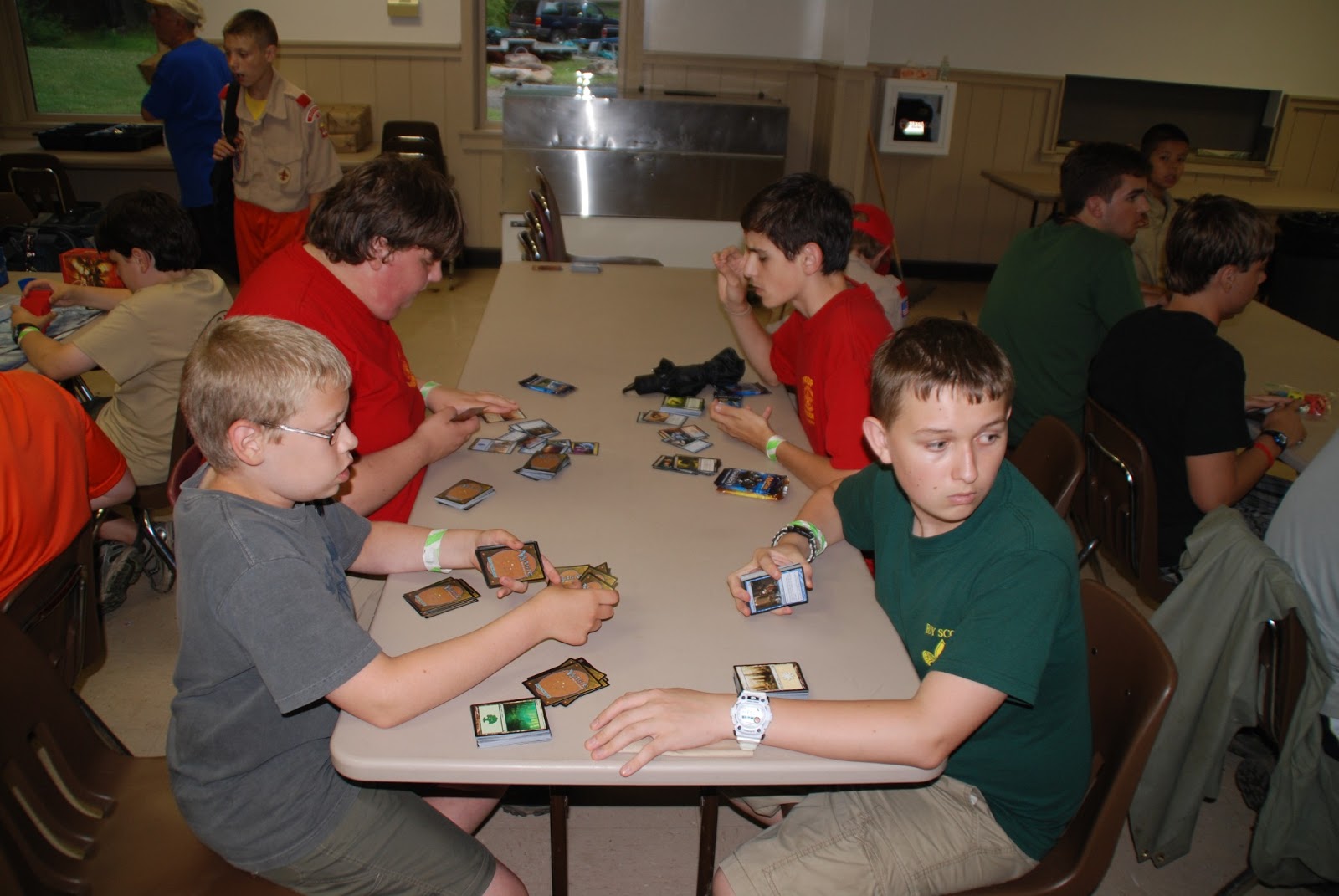
Photos of the half of the Dining Hall in use for Magic Night

Terry runs a very tight ship, and his experience shows it.   But don't let the short clock or limited sealed pool offerings fool you - Scouts know how to game under pressure and almost no one goes back to their tent unhappy.   While he is no longer a staff member of Ockanickon, his smile and presence is welcomed by all. Magic Night at Ockanickon is seen by many as the highlight of their summer camp experience.   When you offer a program as deep and varied as Ockanickon's, that is high praise.

The Game
This past Tuesday night, Terry was a little overwhelmed by the number of Scouts that showed up to play (along with a couple of leaders including myself).   He had 36 Scouts for constructed, 27 for sealed and a total of about 90 people in the room at any one time.   In a camp with about 500 campers, that's pretty significant.   Camp staff are allowed to participate, but only in the sealed pools.   Camp staff also helped him run the tables and performed setup, helping to get things running smoothly.


I entered to play sealed.   I figured my skills were best in that area, and I had no idea what weird meta-game I'd face in constructed with so many Scouts from Maryland, New York, New Jersey, and Pennsylvania playing.   My son, Jacob, originally thought to play constructed, but changed his mind at the last moment and entered into sealed with me.   We paid our $20 each, received our five packs and found a spot to start brewing.   Terry got things going immediately, once he had everyone into his database he started the clock on sealed deckbuilding and moved right into registering the entrants for constructed.

Jacob and I both started with 3 packs of Gatecrash and 2 of Dragon's Maze.   While he pulled a Ral Zarak, my best value card ended up being a Watery Grave.   Five packs total to pull from simplifies and complicates brewing.   It's almost a skill unto it's own.   For starters, the obvious thing is your pool is smaller, so it should take less time to evaluate what is good and what direction you need to go into for your build.   On the other hand though, your pool IS smaller.   Meaning you have to be a little bit more creative and you practically have to be in three colors (unless you get a nut draw like my first opponent did).

Son of Magic Dad, Jacob, with his intense game face.

Thirty minutes goes by fast!   But anyone who spends as much time as Jacob and I do drafting, we knew the clock would not be our friend and came up with something we felt we could play with that wouldn't completely embarrass us.   His deck ended up being a patriotic mash-up including: Boros Charm, Ral Zarek, Simic Manipulator, and a choice foil Lavinia of the Tenth.   While he only went 1-1-1, that was a strong enough showing to earn a pack of M13 with a Thragtusk inside.   He made back his entry fee in card value and overall was very pleased with himself.

Decks built and ready to play.

I on the other hand didn't fare so strongly in the rare department.   I ended up with a satisfactory Orzhov/Boros deck though, playing Skynight Legionnaire, Sepulchral Primordial, Warleader's Helix, Ripscale Predator, Weapon Surge (a wicked combat trick that won me a match), and three or four Extort creatures.   While I was fearful I would have an uphill battle, in the end I did well enough to end with a 2-1 finish.   My one loss was to a Scout that somehow pulled a nightmare combination of Selesnya cards - I don't think he could have done better with 8 packs to choose from.   My two packs worth of prizes did have some very playable cards, but nothing that is worth reporting as a return on value.

Turning them sideways!

The best part of the evening?   There wasn't just one.   Playing Scouts from other Troops and seeing the bond that is Magic pull Scouts together in a way that you normally only see when they are faced with a unique task was amazing.   Sitting across the table from a Scout no older than eleven and watching him strategize, while keeping a strong conversation going with an adult was well worth the price of admission.   Watching a number of Scouts from my Troop, who I had only taught how to play Magic a month ago play in their first organized event was priceless.   Even seeing the unique tournament structure that Terry has developed was worthwhile.   When the last match had been reported and the last prize had been given out, I sat down with the man who organizes this weekly tournament to talk about his thoughts on the game.

 Jacob, on the left, battling it out.

Two Scouts, Oliver and Cole, in their first organized play experience.

Meeting Terry
As mentioned, Terry is a recently retired L2.   His real life job as an Actuarial Analyst combined with the fact that these matches are unsanctioned contributes to his no longer being a certified judge.   But that hasn't diminished his love for the game, nor this desire to give back to Scouting.   He's been running tournaments at Ockanickon for 13 years, since Odyssey.    He seems to have it all down to a science.

Terry Robinson calling out pairings.
With a mounted deer head in the background.
Wearing sunglasses.
Your argument is invalid.

(Please bear with me, we had little time and I'm not a journalist by trade.   This ended up being more of a conversation than an interview.   If you've ever talked with him, you'll know that he's fast, smart, and able to leap tall buildings in a single thought.   I really should have recorded it, as I have no skill at shorthand).

Once we covered the preliminaries, my first question was about whether or not he had noticed any growth in the tournaments he runs at Ockanickon.   He was quick to reply that while there's a certain ebb and flow (noting Kamigawa as a lower point in participation), that numbers are definitely up this year.   That parallels what the larger tournament scene is experiencing.

He then jumped right into telling me about the format he uses and the challenges it represents.   When Jacob and I registered, we did present our DCI cards - only to be told the event was unsanctioned.   The format he uses isn't sanctioned by Wizards of the Coast because it's held on private property, thus not open to the public.  He spoke about the challenges of running events that fall outside of MTG's definition of a sanctioned tournament.   One of the biggest issues for him is it's harder to obtain certain product.   Terry mentioned that the most popular product he could sell would be Deck Building kits and other introductory level products, as many of his participants are brand new to the game - where one Scout goes, three other follow along just to see what the fuss is about.

How many Tournaments do you know start with the Scout Sign?

He then changed gears, wanting to accentuate the positive.  One area that he spoke very highly of was of the changes to the rules made in recent years.   While the Comprehensive Rules is still a scary document for some, he notes that the number of rulings he has to make - even at a large tournament of almost 70 players - really isn't more than one or two a night.   Terry expressed that the rules on the cards are so much more clearer than they used to be.

We didn't have much time, but there was one other thought that percolated to the top of our conversation.   Terry expressed that for many Scouts, this night would be the highlight of the week.   For many, this would be there first chance to play in any type of organized play.   Judging by the interactions I had earlier in the evening, I couldn't agree more.   Even lined up outside of the dining hall before gaining admittance, there was an energy to the crowd of Scouts that you don't find anywhere else in camp.   Terry may have been almost overwhelmed with the number of Scouts that showed up to play, but he wasn't going to allow a single one of them leave disappointed.   His prize structure is generous.   Even when Scouts don't win a pack though, the ability to hang out in air conditioning for a few hours of a very hot week can be prize enough.

Final Thoughts
The pairing of Scout camps with Magic - or any other collectible card or board game - seems to be a natural fit.   Scout camps are always looking for unique, fun, and challenging programs for their evenings.   Many fill these holes by offering a movie night or Troop swims at the pool.   But actually offering a mini-tournament using Terry's model is something that I'm surprised more camps don't try to adopt.   Obviously, you need an ambassador with Terry's love for Scouting and Magic to make it work.   You also need someplace on site to hold a tournament that is air-conditioned (humidity is not a friend to Magic cards).   Luckily, Ockanickon has such a place in their dining hall.

I'm paraphrasing some what Terry expressed in his conversation with me, as he thinks that Wizards should create a system that supports programs like the one he runs at Ockanickon.   Unsanctioned events shouldn't have to mean unsupported.   Scouts can have a tremendous organized play experience that is tailored to their needs with support from WotC.   The chance to sell product combined with introducing a legion of new fans to Magic seems like a win-win to me.   Terry obviously felt this way, or else he wouldn't give as much of his time as he does every summer.   So I offer it for consideration: an unsanctioned format, with custom match software, product support, and a registered judge to oversee the event.   Create a system by which product can be obtained that fits the demographic of new students to the game and sold to the Scouts attending.   With camps regularly seeing attendance numbers of over 200 Scouts a week, there is little to no reason why some creative marketing can't make this a more common occurrence.

Terry's thought on this extends to even having a flyer with a list of LGS's that are authorized re-sellers within a 50 or 100 mile radius of camp and how to register for a DCI #.   This would offer Scouts a starting point after they go home at the end of the week to continue playing and building their collections.   People like Terry, who run events of this nature should be able to obtain product and become and authorized reseller with little fuss.    There may be a few naysayers that see this as potentially cutting into their profits.   To be honest, every single one of them should be thankful that in at least one instance, there exists a man like Terry to introduce new generations to Magic, one sweltering week of summer camp at a time.

Here's one more reason to offer more support to people like Terry offering unsanctioned events.   If you were to stop by the Trading Post at Ockanickon during the day, you'd see that they sell boosters, playmats and other gaming supplies in addition to flashlights and hammocks.   Aside from the slushies on a hot day, I didn't see anything more popular in the store than the Magic cards.   It's a phenomenon, and I can't think of a better way to help capitalize on it than to promote the work being done by Terry and helping him to better serve the community.   What works at Ockanickon can be adopted elsewhere with some clever marketing.   With the recent creation of the Game Design MB, there is also hope that a formal agreement can be made at some point in the future with the Boy Scouts of America.

Victor, who only learned to play less than 20 days ago in his first tournament!

And that friends, would be a great day indeed.   Fresh faces, brought up to be respectful and follow the Scout Oath and Law, would create a whole new generation of players.   The perfect match of a quality organized play experience with new people to play the game.


More photos:


Afterword: Neshaminy
Here's my list of the top 10 translations of the Lenni Lenape word for our campsite at Ockanickon.   For those that have camped there in extremely wet conditions, actually for Boy Scouts in general, this should be a good bit of fun.   Everyone else, thanks for reading my article and I hope you have a great week!

10. No Lifeguard on Duty
9. Good Fishing Grounds
8. Bathing Attire Required
7. Land of the Longboat
6. Just Add Water
5. Muddy Swimming Hole
4. Campsite That Will Not Drain
3. Home of the Wet Sneakers
2. Wooded Home Surrounded by Frogs (you had to be there)
1. Birthplace of the Muddy Slip-and-Slide

The actual translation for Neshaminy is believed to be - "Place where we drink twice."   I think that is an incorrect translation.  It should be, "Place where we were dunked twice."   Long story behind that one.   Seriously, it's all in good fun, we had a great week there and I hope Troop 94 will choose to return to Ockanickon.   Thanks go out to Bill and his camp staff for making the week memorable.
____________________________________

Reblogs & Retweets & Mentions of all kinds are appreciated - as an independent writer I'm only read when others like what they see and share with their friends.

Photo credits: Christina Preissman, Charles Featherer, Ed Heierbacher (Ockanickon Staff)

Tuesday, June 25, 2013

Great Job, Tim!

This week, I have to give some serious credit where credit is due.

I can pretty easily imagine what goes into making a standard GP or similar event happen.   Physical arrangements, judges, materials/supplies, guests, vendors, VIPs, artists, and more must all come together in perfect harmony to make the event seamless to the participant.   These events, while pretty pat do run into problems occasionally, especially when more than the expected number of participants show up to sling spells.

In the days running up to GP Vegas, the number of preregistrations coming in was astonishing.   I (and many others) made predictions months ago in the 2-3,000 participant range.   Twitter was afire in the final two weeks of preregistration, as it suddenly seemed possible to smash the previously held record for a TCG event.   In the final days leading up to the GP, it became clear that 4,000 to 5,000 or even more participants would be possible.

And what was better is the Tournament Organizer (TO) for the event, Tim Shields, came out on his blog in the early part of the week before GP Vegas and said that he was ready for up to 6,000 or more.

Let that sink in for a moment.   6,000 or more people playing Magic the Gathering in one place at one time.

Over the next two days though, Tim had to step back, reevaluate and change his tune.   Was he right?

Logistics, Logistics, Logistics
It's a well known idea that an army is only as strong as it's supply chain.   No food?   Soldiers don't fight.   No fuel?   Vehicles don't move.   Planning and running a GP of any scale works on many of the same principles.   TO's must find enough qualified judges, space for the mobs, and enough tablecloths for all of their tables.  They have to worry about every little detail.

Following Tim's announcement via his blog that all was well, the next day another blog post came out.   And things were no longer perfect.   He discovered at least one problem to running an event of this size...human error.   It wasn't his error.   It was the approximately 10% of errors made by players when entering their DCI # for registration (note to WotC - is there some way to make the preregistration process validate name/DCI # for prereg??).   In combination with some qualified individuals, Tim Shields made what I know was a tough decision - he capped the event.  And he was right to do so.

No longer would he have to worry about 6,000 or more of his closest friends showing up to party in Vegas. Now, he just had to make things work for the 4,500 that would officially play in the GP as well as assorted guests and those that would arrive to participate in side-events.

Even as D-Day drew closer, it became clear that capping the event was a good idea from other logistical angles.   Last minute calls to judges were made.   Lines of up to 2 hours or more were heard of on Friday.   People waiting from approximately 3am on Friday morning to get one of the last 100 spots.   And we won't even mention the little snafu with product that was a little behind schedule to be delivered.

I Told You...ah, Forget It
It's not worth saying, but I saw this coming.   A GP with 3,000+ participants?   Absolutely possible, and with the popularity of the Modern Masters product, almost a given.   The only question was, would enough people travel at least 200 miles or more to make it a success?

Buried in my feedback for my first Blog posting here as Magic Dad, was a great letter from a TO of some renown    In the letter, the gentlemen who we'll refer to as 'TS' wrote that he appreciated much of what was said and that he is striving to avoid mistakes in the future as a TO.   He talked a bit about what preregistration numbers meant to the final tally - how does one predict attendance based upon prereg numbers was a central theme.   As TS closed his letter, he said, "...I understand that we need to get way better at running complex events as these things go from 500 players at a GP to the 5000 person GP of my dreams."   Wow.

Is Tim...err, TS...precognitive? 

Bitter Pill
It is a bitter pill to swallow, making last minute changes to an event that will shut out some players.   It's even harder to do when you strongly believe in your event and offering the best service possible.   But Tim showed some great character in doing so.   It wasn't an event I was going to be at either way, (I'm on the east coast and traveling to a MTG event more than 2-3 hours isn't something my wife really...understands).   If I could have gone, because I had to make arrangements in advance I would have absolutely included preregistering.

In fact, I'd likely do so at least a month or more out from the event.

So why didn't everyone else?   Why is it that even in the last week, Tim took on 1,500 more registrants?   A full 1/3 of the people attending?   Didn't they know they were going to go?

Let me ask this another way.   You  want to attend a concert to see your favorite band.   Mine is Metallica, so I'll go with that for this example.   To get into a venue with limited seating and to participate in a popular event, you plan in advance.   You schedule time off from work, just to buy tickets.   When they open up ticket sales, you jump online, sweating bullets (sorry, wrong band) that you'll not get the seats you want.   Or worse yet, that they'll sell out in 10 minutes and your transaction will take 12 to complete.   A 60,000 seat stadium can be sold out in less than 30 minutes.   Why is this so different than an MTG tournament?   MTG GPs don't have unlimited resources.   Both gamers and TOs recognize this.

Granted, I don't think I'll get to see Kirk Hammett at a GP, but still...

The point I'd like to make is, Tim made a tough decision.   But he did so knowing several things.   He knew that he had offered preregistration for some time, and that dedicated players had already registered.   He knew that he would still keep it open for another day or three, depending on how many signed up.   Tim tried to make the event as accessible as possible to all players, but he knew that issuing a cap was the right thing to do when faced with the alternative.   He had to choose between disappointing players who didn't plan things out with disappointing players who had planned and payed for the privilege of attending.   You can do the math on that equation a hundred different ways - but every time I do it I come up with Tim's answer to the problem.

One Step at a Time
Tim Shields is a TO who made the right decision in a difficult situation.   He ran an event that many reported to be smooth and without any major problems on a scale never before seen in the MTG community.   He did it by planning far in advance and working his plan.   Yes, he did make a mistake in projecting the human error component (if you can call it his fault people make mistakes).   He offered heartfelt apologies for this.

He also made some improvements to the experience for players, by offering and promoting preregistration as the best way to get a seat at the table.   If we all learn one lesson from this, it's this: Preregistration Works.   I don't want to call it a done deal yet, but I do foresee the next change to MTG events being preregistration is the only way to register for larger events.   To make it really work, you have to do two things though.

First, you should find an incentive for preregistration that encourages players to use this process.   Either a choice product (a special token, playmat or other game gear) or a discount.   I'm not talking to TO's that do this already.   Those that don't need to find a way to sweeten the pot, just a little bit.

The other thing you must do is learn from Tim's one or two miscalculations for this event.   I think it's not unreasonable to state that you need to place an absolute upper limit on the number of registrations you're willing to accept, based on your capabilities to host the event.   Tim did do this, it just ended up being that he had to make a late adjustment based on new information.   Remember, there are only 40,000 seats for that Metallica concert - just as there are only so many judges, lands, or tables available.   Please don't state you can handle X number of players when there is a limiting factor that says the real number is X-500.   I'm not faulting Tim Shields here, but I am stating that his experience is one that all TO's can learn from to provide even better service in the future as GPs continue to increase in size.

Applause
So let's do this.   Everyone who attended the GP in Vegas should send Tim a message via Twitter (@timothypshields), thanking him for the event.   Even if you tilted horribly and dropped day one, recognize that organizing an event of this magnitude and running it as well as he did deserves some special recognition.   When you see a Judge, thank them as well - they helped to make the event what it was.   I'd encourage everyone to thank special people at WotC as well, but don't forget to show Helene Bergeot some love as well via Twitter (@helenebergeot), I understand this event fell largely into her domain.

While we're on the topic thanking people, remember to thank your LGS for supporting the game and giving you a chance to draft or play in a format.   The support for GP's like Vegas really starts there.

When you're done thanking everyone, you can go back to the debate of the day on Twitter or Reddit.   But only once you've made sure to thank these awesome people for helping you set a record and attend an event that was, by all accounts, executed without any major problems or delays.   That, my friends, is a miracle.


Wednesday, June 19, 2013

Getting Committed

I'm a person that enjoys writing.   It helps me to exercise my demons.   Even the nasty little blue ones with sharp pointy teeth can be driven out with a good session with a word processor.   The mere act of putting something onto the screen helps to remove angst and feelings that are bottled up inside of me.   I'm also a voracious reader, but the act of reading is fundamentally different than writing.   With reading, we consume and ingest someone else's works.   We enter their world and are trapped in it for a time.   By writing, I have the ability to give weight to the many ideas that roll around inside of my head like a sea of chaff.   I can distill my thoughts down to 26 characters arranged in a fashion to convey love and hate, joy and sadness.   It's a wonderful feeling to get all of these random thoughts that bounce around my head down in some permanent form that others can read and comment upon.

Writing, to borrow a rather trite expression, is a cathartic exercise.   The act allows me to wrestle with concepts and free them to the world.   But there are dangers in writing.   While sitting at a desk in some anonymous residence, I'm invincible.   I can slay dragons and rescue damsels.   Or rescue dragons and slay damsels, such is the power of the word.   The minute I select to publish though, it's free.   Free for consumption.   Free for interpretation.   Free for criticism.   Free for distribution.   Just as the act of writing is freeing, the act of reading is the opposite.   People are incarcerated by things written by not just me (poor, lowly me) but by thousands of pundits, reporters, and authors across the many mediums that allow print to be given unto life.   The act of publishing a written work puts it in the public domain for review, trapping the reader in the writer's interpretation of events.   What is more scary though is it traps the writer into the reader's ability to interpret the intention of the piece.   Be it a Twitter post or a 1,000 page novel, the writer is as trapped as the reader until the journey is complete.

All of that doom and gloom aside, I hold a neutral view regarding the publishing of things I write.   I can't always make people see things the way I see them.   I am as open to be being misinterpreted as any other writer.   Sometimes, that causes me discomfort.   I want others to accept what I believe are rational arguments.   I want others to feel the emotion I express.   It's not always the case though.   There is something I find more dangerous though than writing a viewpoint and having it misinterpreted.   It's the act of writing something personal as a declaration of self improvement.   Stating, "I'm going to learn how to rebuild a car engine," is limiting myself to a particular act.   What if I fail?   What if I can't figure out how to time a carburetor or misunderstand how to use a torque wrench?   The act of placing a promissory statement in regards to self improvement is one I've often shied away from because of how limiting it can be.   It places handcuffs on my wrists that can't be removed when the readers stop reading - because I know I wrote it and it's out there.   It's a trap within a trap.   Today though, I'm going to make a statement regarding self-improvement as it relates to Magic.   And I want to challenge others to do the same.

Kitchen Table
We all play MTG in a variety of formats.   Some of us like EDH but hate limited and cube.   Others of us only play casual Magic, mixing things up over the kitchen table until we reach wild board states WotC never thought possible.   I've professed my own love over playing limited and my personal confusion at the Standard meta game.   You might think that's bonkers, that the only way to play is Standard, or Modern or Vintage (let's not even talk about Extended, perhaps the most unsupported format in the community).

No matter what format we choose to play, we all do so with a passion.   I've recently expanded my repertoire using EDH and my box of Modern Masters as a springboard.   No matter what I play, I find an increasing love for the game every time I pick up a deck and roll dice for turn.   One thing continually strikes me though.   If I don't have Larry around (my LGS's local rules guru), I feel like I'm flying blind.   I 'know' how some cards are supposed to work with others.   I'm particularly comfortable playing the newer blocks and formats.   EDH and Modern Masters has opened my eyes a bit more to the wider world of card interactions.   Splicing, for instance, is insanely cool but a little bit complicated.   While I have moments when I feel stupid, that doesn't mean I feel good when it happens in the pursuit of new formats and game styles.

I want to understand how the stack works.   I need to know how to work out complicated layers questions. I've want to grok who has priority in any given situation and what to do with the new legend's rule.   So it's time to graduate from Kitchen Table Magic.

Judge!
I've been impressed at all levels with the Magic Judges I've seen and interacted with at events.   I consider them a class above the rest.   I've decided (and this has been on my mind a great deal lately), that I want to be a Magic Judge.   Cue the Rocky music.   Cut to the training montage.   Just don't do a head-shot - I'm not Hollywood material.   Perhaps we could get someone like Brad Pitt to play me...   Oops, sorry.  I drifted off topic for a moment there.

I know there are people out there that will help me with this endeavor (Rocky music slowly rises in the background again).   I'm not sure at the LGS level how that will work out, but I do have a friend who has already offered to help me in this endeavor from a store about an hour away.   I've got a few reasons why I want to do this, some are more personal than others.   But I think it's important to try to share them here.   If I'm going to go all in, I may as well do it with some style.

My first reason is simple.   Please don't gasp when I state it out loud - you'll wake the baby.   Folks, Magic isn't cheap.   There's a reason people call the game cardboard crack.   As a hobby just for myself, it would be one thing.   But I've got a 12 year old in tow everywhere I go that wants to do what I do (and vice versa, to be fair).   Every time I pay for a draft, I'm paying double.   Every time I pay an entry fee?  Double.   Food?  Double.   Come on and sing it with me, Double, Double, Double...   Long term, there are two sustainable models.   Actually, there are three if we count the lottery.   But the hard truth is that I can choose to either play a lot less and not take Jacob to as many events and FNMs or I can work on becoming a Judge, thus helping to lower my costs over time through participating on a different level than as a player.

Finances though aren't the only reason.   If it were, it wouldn't be enough.   I'm a firm believer in service to organizations I care about.   I see Magic as not being much different than Boy Scouts in that regard.   As a leader in Boy Scouts, I've got 14+ years of volunteer experience.   Giving back to help something grow into something better for tomorrow is a worthwhile goal.   Combined with my time in a field of work that relies on customer service, I'm sure the combination of wanting to give back and serving others will work well for me as a judge.   I know donning those black threads is something many experienced players can and should do.   I also realize that not everyone has the ability to deal with someone that has just lost a significant decision.   I'm positive though that I have a pedigree of experiences from my vocation that will serve me well as a judge.

My last reason is perhaps the most selfish.   It's also the reason I imagine many others get into this side of Magic.   I want to better understand the rules.   I don't want to do this to know how to bend them, I want to do this so I know when others are doing so.   I trust a great deal in what my opponents tell me about their board states, as I am often more concerned with mine.   However, the comprehensive rules for Magic are several hundred pages long (I know, as a player I've already read them twice).   To really understand how something on page 56 interacts with something on page 211 is still a mystery to me.   I want to know how to read and interpret the layer upon layer of complexity that powers the MTG engine.   I'm sure I can do it, but without a goal beyond my kitchen table, why would I bother?

Commitment
I'm setting a goal for myself that is quite frankly a bit daunting.   I know that the rules and interactions are complex.   I also know I'm committing myself to a serious goal here by simply putting this down for others to read.   No longer will this be something, "I'd like to do."   Now it is something I will do.   No more lurking in the Judge Tutoring Facebook page for me.   From now own, I'll take a crack as I have time at answering questions.   I'll open up the Comprehensive Rules and start reading through them again.   I'll reach out to my friend (Judge and TO Nick Coss) and ask him how to move forward with learning some of the more complex interactions - or better yet, when I can next come to his store to help out with an event.

It won't be easy.   The hardest part will be the time commitment as I work full-time, volunteer several hours most weeks with Scouts, and I'm a college student as well - kids, finish your degrees when you're young.   But I will do it.

I'll take the black.

[Cue crescendo, ascend steps of staircase in front of Philadelphia Museum of Art, raise hands in air and fade to black.]

__________________________________
This story has been sitting in my list of ideas and stories for over a week.   To be honest, I'm scared of making this type of a commitment - or rather, to make it as a public declaration.   I almost didn't post it.   But I want to see others step up to the challenge.   So I hit the publish button.   I'm not asking for blood, just a little bit of your time if you read this.   Consider what you can give back to the game.   If you don't want to be a Judge, find some way to give back.   The game will be better for it.

Thursday, June 6, 2013

Five Things I Think...

Today, here are 5 things I think I know about MTG:

1. Modern Masters: This special set will be a smashing success.   Wizards will make money, LGSs will make money, traders and the secondary markets will make money.   No cards will go down overly much in value, in fact most should remain at their value or spike slightly in price.   I do not think it will have the intended affect Wizards of the Coast hopes for - at least not to the scale that they desire to see Modern become an increasingly popular format.   They'll learn lessons from this release, and likely have a MM2 within two to three years.   (I strongly disagree with anyone that thinks it will happen next year - to the point that I'd put money on it).

I've already written why I think this set will have problems fulfilling the expectations of WotC, but here it is again in a nutshell.   The overall cost of the product, often highly inflated above the suggested price, is a big red stop sign to many players.   If you're not going to GP Vegas (can you say 3,000+ guests?), than you're likely going to be paying at least $200, and more likely $250 or more for a box.   For those that get it below $200, congrats.   However, all that aside this will be phenomenally successful.

2. Modern Masters (Part Two): I am excited to get my box at the MSRP - thank you Top Deck Games.   I can't wait to open it.   What I am having a hard time deciding is in advance is what to do if I hit a few money cards.   Trade them back and buy another box?   I think that's the move, but I honestly don't know.   I do turn a little bit into Gollum when I think of foil 'goyfs and swords.   My precious...

My ultimate goal is I want to be able to build a couple of fun Modern format decks.   I don't expect my Modern constructed deck to be competitive.   Yes, even though that last statement sounded counter-intuitive I do mean it exactly as I said it.   Is there a player of Modern out there that isn't a Spike and doesn't just want to smash face?

I don't, at least not in constructed.   In constructed, I'd rather learn how to play.   I want to have a good time.   I'd even like to have a conversation with my opponent before and after the game.   In Limited format, I'd absolutely like a little bit of face smashing.   But I'll be lucky to draft this in a group more than 2-3 times.   It's a big set with a high learning curve for people that have been playing as long as I have and it's expensive.   Even if you can find a draft where they aren't charging much more than MSRP, unless you're independently wealthy you likely aren't drafting it much.

I'm anxious to hear about people's experiences with this new format, and I will try to write about mine if they're exciting enough.

3. EDH: I think that by the end of the year, we'll have 4-6 new EDH products from WotC.   This is a best guess, but I really do feel that with the increasing popularity of EDH as a format and given the initial overtures by Wizards were very successful, they can't help but follow-up with another run of custom decks.   Two things would make this even better - one, each deck has a chance for a bonus commander and two, there will be at least one new card for each deck that will only be available to EDH players.

I'm also finally playing my EDH deck I built a couple of months ago.   This may sound blasphemous to some of you, but I can't tell you how much more fun it is to play than my Standard deck.   I can't get enough of it.   My general is Aurelia, and while I rarely get her to the battlefield against my son's Ruric Thar deck, when I do it's glorious.   I practically thump my chest when it happens.   As an aside here, for a little dude that's probably spent less time building his EDH deck than he has reading the rules, his deck is always a handful.   My deck is a study in what I have versus/what I can afford/versus what advice I've received - in theory it should be leaps and bounds ahead.   Yet he constantly finds ways to beat me.   I don't know if I want to start tinkering with my deck yet.   Perhaps it's time to start building another one?

4. Drafting Nightmares: I know I practically wake up with cold sweats now the night before a block draft.   It's just that scary.   I've played it 4-5 times.   I've read just about every article out there.   And I've really thought I've been smart, or clever, or strategic or ... [insert your favorite synonym for intelligence here].   I haven't broken 3-2 yet.   Last week I went 1-2 with what I thought was a pretty vicious Gruul splash black deck.   That's not so bad, at least I'm above 50% overall, right?   For someone who's still a drafting infant compared to some of the weekly competition, isn't that respectable?

Unfortunately, it's not for me.   Here's why.   I'm not comfortable.   Let me break it down for you, so we can all look at it.   It starts with Pack 1.   Dragon's Maze.   10 Guilds, one Pack, few common playable cards, maybe.    Questions about whether or not you have to telegraph what guild you want/need to be in and which pack that is.   Tough choices among the uncommons and rares abound.   Do you choose that Orzhov card, or do you go with the Gruul?   Gold card or standard?   Draft gates early or late?   There are as many strategies as their are guilds - actually, there are more.   The funny thing is, this set is so well balanced that it depends more on your bombs, removal and play style than it does on what guild you draft - at least, as far as I can tell.   (Noted exception, Dimir is still difficult to play well).

And there are at least six players at your table (hopefully eight or more).   This isn't your mother's M13 draft.   Oh no sir, this is a whole different animal.

So you pick likely 3 colors out of Dragon's Maze.   Maybe you splash a few gates to help you on your way.   Then you start up with Gatecrash followed by RTR.   The second two packs of this block are where things get dicey.   Why?   You guessed wrong.   Either someone to your right or left starts cutting you at a critical time.   Or what's worse, because there is only one set of packs instead of three that server your guild, you don't find any fixing.

I spoke with a friend at last week's draft.   I asked him what his impression was after having been able to draft it a few times more than I had - and I don't think he had any better feel for it than I did.   Of course, he beat me pretty soundly later on in the evening, but I don't think he knew why his deck worked anymore than why mine failed.

I'm a self diagnosed Timmy - but I like to at least understand and plan a bit of what I'm doing.   This limited format is crazy.   Not necessarily in a bad way, but it is crazy.   So here's what I think.

I think that TO's and LGS's should find a way to order and store a fair bit of RTR, GTC and DGM stock.   Anything less than 5-10 full cycles is ridiculously near-sighted for any store with a dedicated base of players.   When this format goes out of rotation, it will be a drafting gold standard for years to come.

5. Vintage: Lastly, I think I wished I played Vintage.   I wish so much for that depth of knowledge of the game and for the cards to play at that level.   I want to be able to do this.   To be able to play at my friend's coolest Magic event of the year and feel like I belong.

But here's the thing that I've learned about Magic.   I don't have to play Vintage to attend the tournament.   I don't have to even know what it is.   I just have to love the game.

And because my friend is the TO, I know something else.   I'm saving the date.   Not because he's my friend, although for me that would be enough.   No, it's because he knows Magic.  It will be worth the drive just to see the side events, the people, the artists and the product.   I fully expect we'll get to play some fun drafts.   I hope to get to spend time meeting some great people and talking with them.   Perhaps above all else, I can't wait to be introduced to what it means to play Vintage, and to share that with my son.

Jacob and I will be there in November, and we'll bring our decks, binders and a great attitude.   Perhaps we'll even bring some SJ attitude with us.

November 1-3, Philadelphia.   Be there folks, for the return of the Eternal Weekend.   Maybe together, we can figure out what an 'eternal weekend' is and how we can make more of them.   Hosted by Card Titan, it will be an event to remember.   I can guarantee you that.


As always, feedback is appreciated and sharing it via Twitter/Facebook/Tumblr is even better.   Being an independent blogger, if you don't help me share this, it doesn't get read.   I don't charge or advertise, so if you enjoy this help me by spreading the good word.

Thank you for reading!