Wednesday, July 24, 2013

My Hall of Fame Vote

I'm really excited to be picking some players for this year's Hall of Fame.   My first and easiest selection was of course, Chris Pikula.   I do understand that most everyone's first pick was the great LSV, but I go for the altruistic vote first - and in this case Chris has it in spades.   Oops, I guess I spoiled my second vote, it's none other than LSV.   His play is almost as good as his legendary puns.   When you think of limited, if his name as a Pro Player isn't the very first you think of, well, you're not in touch with the community.

My third pick has to be... {KNOCK, KNOCK}.

Sorry, let me get that, I'll be right back...

Oh.   Oh my.   It appears there has been a mistake.   I don't get a chance to send in a ballot this year, there's been a horrible misunderstanding on my part.   Aside from the fact that voting has closed, there's another little detail.   Only a few people in the Magic community are allowed to vote.   In fact, I probably won't ever be eligible to vote on this topic.   If writers for major support websites that have five years or more in service don't get a vote and people like Nathan Holt aren't asked to be a part of the selection committee, the chances of me participating are about 1,000,000 to 1.   (I stopped at a million because I didn't want to bore you with zeros - nothing is more boring than zeros).

So why write an article about my picks?  Or what they would be?   Better yet, why should I spend one second of my time as a player reading the seemingly endless array of articles by those on the committee defending their votes?   Seems like utter non-sense to me.

Let's back up for a second.   Surely there is some logic behind the current system.   I'm too new to know all of the reasoning behind the vaunted HoF selection process.   I'm obviously too wet-behind-the-ears to appreciate the nuance of selecting a candidate to vote for from the tremendous field of eligible and esteemed Magic personae.   **POP**   I've just removed the tongue from my cheek.   I'll be good from here on in, because I think there is still a worthwhile discussion to be had here about the current process and how it may (emphasis on MAY) be changed for the better.

Ground Rules
I'm going to debate two sides to this argument.   You'll see them both.   I'll only use what I've learned in the past few weeks along with my own opinions.   I am going to try to convince you, using both voices, that the opinion being expressed at the time is the only opinion worth considering.   To make it sporting, I'll take the voice of someone who wishes to maintain the current system.   Then, after you've read both arguments I want you to think about them.   If one of them hits you particularly hard, I encourage you to comment about it.   Use any method available to you - but know that Twitter seems to be the place that professional Magic players hang out and ultimately they are the ones that may have the most to say about changing the system.

Your ONE job is to look at both sides as objectively as possible.   You don't have to comment.   But I want you to try to look at both arguments with a blank slate.   In the end, you may be surprised by which side makes you feel more interested.

Support the Current System - Down with Change!
*Ahem*

Is this thing on?

Ah, it is.   Well then allow us to proceed.

There is one thing you need to know before we begin.   In fact, this one thing outweighs nearly all other considerations and arguments to be presented.   It is so important, I could simply close when I'm done saying it.   Ready?   It's not the Magic Hall of Fame.   It's not the Magic the Gathering People's Choice Hall of Fame.   The official name of this is the Pro Tour Hall of Fame.   Let's let that sink in, shall we?   The Pro Tour Hall of Fame.   Pro Tourrrrr.   It's not the Tom, Dick and Harry Hall of Fame.   This is for the elite players of the game.   Those who have repeatedly proven themselves as spell slingers of the highest ability.   Why on earth should we need to expand the voting to include everyone?

I can stop here, and my argument for not changing the current voting system would be safe from the drivel that is to follow.   Pro players around the world would give me a nod, or a golf clap and feel that the system would stand up to any further inspection.   They're right.   But let's look at this from another point of view.

Pro players and other members of the selection committee (including those who have had something to do with the Pro Tour in one capacity or another over a period of time) all have one advantage over the rest of us.   Actually I think it's two distinct advantages, but we'll treat it as one for the sake of brevity.   They know the candidates.   Brian Kibler, one of the many members of this year's selection committee actually knows and has played against a number of the eligible candidates.   Sheldon Menery has spoken to candidates either in a coverage capacity or as a Judge.   Mark Rosewater...well, we get the idea.   These people know more about the candidates for this year than we do.   The know whether or not this person shares their knowledge.   They know what kind of player this person was in the 90's.   They know whether or not this person has spent their time and efforts supporting the game and to what extent.   In short, Pro Players and those that interact with them know Pro Players best.

Truth is, this system has worked rather well.   Players are judged in areas that matter beyond their lifetime Pro Points.   Integrity, Sportsmanship and Contributions to the Game are all considered and weighed.   There is no need nor desire by anyone to change this existing system.

You're still not convinced?   Then let's try this argument.   Any other system would be needlessly complex.   How on earth can we open up voting to everyone who plays Magic?   What bloody safeguards would be needed to make certain some knucklehead IT guy doesn't send in 300 votes for someone who's integrity is questionable at best and who never spent day one advancing the game?   It'd be chaos, and I for one would not support it.   A limited voting pool is obviously the only clear choice.

And now, we'll give my opposition a chance to speak...

Burn this Sacred Cow - Let's Change the HoF System!
Now that evil Magic Dad has spoken, it's my turn.   I'm going to ask one question first.   Why, for the love of all things holy, do so many pros write articles justifying their vote or talking about the process when only approximately 250 people can vote?   That's less than 1% of Magic players out there.   Heck, it's probably 1% of 1%.   It's like dangling a 14-ounce steak before a mob of toothless carnivores.   They know they want it.   They can practically taste it.   But they have no means of actually eating said steak.  Their only means of interacting with such a juicy morsel is visually and on the whole, completely unsatisfactory.

Let me say it again.   The current process is unsatisfactory to the thousands upon thousands of gamers who watch the process in intimate detail but have no ability to interact with it.   It may not be in danger of failing yet.   But it surely isn't very satisfactory in it's current form to many players.

Over the past few years, I'm led to understand that the Pro Player system has greatly evolved.   It has done so apparently to create a marketable entity.   Wizards treats the system as a means to drive business in a positive fashion (as they should).   Magic players the world over have started to identify more with particular Pro players.   I'd like to think that I personally identify with players like LSV and Kibler.   Their individual play styles speak to me, as I'm sure Eric Froehlich and Brad Nelson speaks to other players.   This is a byproduct of the current Pro Tour.   Elevating particular players to a status where we appreciate who they are and then we as players move to emulate them.   They, whether they want to be are not, are being elevated to the level of rock stars.

That helps Wizards.   Because to emulate our favorite Pros, we have to purchase product.   We have to invest time in Grand Prix events.   We want to win everything from FNM to *GASP* a seat on the Pro Tour of our very own.   We end up spending more, which in turn helps to sustain the Pro Tour system up to and including the Hall of Fame.

But when it comes to the HoF, our participation stops.   We feel the bitter disappointment that we can't participate further in the journey of our favorites.   We no longer have a stake in the game.   We watch as discussions rage and Twitter erupts for over two weeks on the topic, but have no real say in the matter.

We could get better at the game.   We could spend weeks and years of our lives in pursuit of something that may or, more likely, may not happen.   Or, Wizards could find a way to allow us to participate in the final step of a Pro Player's career.

This year, we may see a slate of HoF candidates enshrined that are all Americans (for a host of reasons up to and including it may be that they are the best options of the available candidates).   Would a popular vote of some kind change this dynamic?   And would that be the worst thing that could come of this change?

I propose that it's not hard to come up with a situation that engages Magic players the world over in one final step of the journey.   And it could be eminently fair to everyone.   It would take two steps.   First, give the current selection committee a weighted percentage of the overall vote - their experience does matter.   Perhaps 80% would be fair to everyone.   Then, allow for 20% of the weighted vote to come from you, the gamer.   To make this as fair as possible only allow us to vote for 3 candidates total (not the 5 allowed the selection committee) AND only allow voting through our Planeswalker account.   Votes could be tracked and limited this way to no more than one per person.   Any shenanigans that are detected could be invalidated - or if necessary invalidate all of the popular vote.   By tying it to a Planeswalker account, players the world over would have a chance to participate and perhaps make the voting more equitable on a global scale.   To be absolutely fair, Wizards could even set it up so the first year they introduce it our vote doesn't count.   We'd essentially beta test for a completely new method of voting for the HoF.

Wizards wants to use the Pro Tour to promote Magic.   I suggest that this system of weighted participation, does just that and more.   It provides a voice, limited but a voice nonetheless, in the final disposition of the ballots.   It gives the casual player or the weekend grinder a vote in one of the most exciting debates annually in Magic (or rather, what should be the most exciting debate).

Sending in the Ballot
I submit, my reader whoever you are and where ever you are, that there is something to be considered here.   The Pro Tour Hall of Fame is not the Grammy's or the Academy Awards.   This is a game that is supported by the community at large in such a way that music and movies are not.   We're not just end users.   We are commentators and game designers.   We are teachers and active participants.   We are fans and gamers.

We are legion.

(Oops, disregard previous - I'm getting zealous again).

We love this game for a host of reasons.   I think that my love of the game is no less than a Pro Player's.   In fact, my enjoyment may at times be greater.   I'm still discovering new things.   I'm still finding out about cool rules interactions and game types to play.   And I'm always finding a new friend.   I don't have to deal with the grind weekend to weekend.

Perhaps that is reason enough to maintain the status quo though.   I can see it, these people on the selection committee have rightfully earned their place (I speak of them as a body, I don't have any idea if there are some silly politics there regarding selection).   They are the people we look up to and they should have some perks as such.   And what would 3 weighted selections given to the average gamer do to actually change the outcome?

Perhaps though, those 3 votes per player that count only towards 20% of the total vote prove the Pros are right on the money.   There may be middle ground here that satisfies everyone.


Before I Go
I have two final thoughts.   The first is that this post was born as another concept.   I'm still exploring the first idea.   I'm not sure how best to express it and I've spent time talking to various people in the community about it.   I'm tremendously excited by the concept and I know it will see the light of day soon.   As I was struggling with my first draft of it though, an off-hand concept regarding how we may seek to improve the HoF system was born.   I sincerely recognize that the current method is one that is tested and works well.   I simply can't leave some things alone.   I only hope that the discussion that may follow is immune from some of the typical vitriol that is seen these days on the Internet.   Which brings me to my second comment.

In the past few days, there was a shake-up on Twitter.   I won't go into it is deeply personal for a number of the people involved.   Those that follow Magic players and personalities I'm sure you at least picked up on it.   I want to offer one statement regarding this incident and life in general.   Please leave the people involved alone, unless you have something to say of a supportive nature.   The veil of anonymity provided by Twitter doesn't give people the right to be cruel.   I doubt one person who had a negative thing to say would have done so to the any of the principals in a personal, one-on-one.   Your parents (or those that raised you) taught you better manners than that.   I know that if you're reading this you aren't likely part of the problem - many of the comments likely came from male gamers under the age of 20 that had nothing better to do with their time and no amount of common sense.

It sounds a little preachy, but that is what it is.  Leave them alone.   Be kind if you can't.   Keep your nasty, snarky comments to yourself.   And if you can't do any of that, remember.   Karma, my friends, is a bitch.

____________________________________

Reblogs & Retweets & Mentions of all kinds are appreciated - as an independent writer I'm only read when others like what they see and share with their friends.   In this case, you may not like what you see though - but please share it with your friends anyway.

Thursday, July 18, 2013

Achievement Unlocked: Becoming Johnny

Let's start with a pair of definitions from Mark Rosewater (footnote 1).   My G&T teacher in middle school was fond of creating boundaries in speeches through the use of defining a key term - and I see no reason to go back on that advice now.   (Probably because I still fear her wicked stare).

"Timmy is what we in R&D call the 'power gamer'. Timmy likes to win big. He doesn’t want to eke out a last minute victory. Timmy wants to smash his opponents. He likes his cards to be impressive, and he enjoys playing big creatures and big spells."

"Johnny is the creative gamer to whom Magic is a form of self-expression. Johnny likes to win, but he wants to win with style. It’s very important to Johnny that he win on his own terms. As such, it’s important to Johnny that he’s using his own deck. Playing Magic is an opportunity for Johnny to show off his creativity."

How many of you remember that moment you changed from being a Timmy into a Johnny?   Or from a Johnny into a Spike?   What was that golden moment for you as a player when you evolved?

Me, Myself and I
I've been a proud, self-professed Timmy for some time.   I like playing mono-red with Thundermaw Hellkites.   I enjoy smashing face and turning cards sideways.   My win percentage isn't anything to brag about in Standard or Limited, but when I do win I generally do so very decisively with big, nasty creatures or powerful spells.   When I draft, I'm always looking for bombs then creatures.   I worry about removal, combat tricks and combos when I'm darn good and ready.   Which is as you're likely aware, is too late to do anything about it in most cases.

I am, by every measurement and definition, an old and goofy Timmy.   I enjoy the game for the game's sake. No deck is to tricky for me to play against, no opponent is to smart.   On any given day, I believe my stable of big nasties will overwhelm my opponent - if only I can get to them.   I have my share of nemeses that I will one day defeat, some of them have beaten me consistently since I've started.   There is a part of me that wants to beat them as a Timmy, but the reality is a Timmy may not have the right skill set to do it in any format. 

I think 95% or more players start as out as a Timmy.   The rare exceptions are those people that come to the game with a definitive skill set in place from other similar games.   While there is a part of me that wishes I could say, "I was always a Spike or a Johnny from day one," I know it would be a lie.   To be honest, I'm proud of my status as a Timmy.   It fits me and my play style.   My son, Jacob, is also still a Timmy.   I'm sure he'd be happier as a Johnny.   From what I've seen, he'll make a good one.   He loves to brew up the jankiest of decks.   When he spends a little bit more time figuring out combos and rules - he'll take the next step.

Dispelling the Myth
Those preceeding paragraphs are 100% true.   Almost...

A few weeks ago, I was drafting in a DGR format at my local LGS.   I wanted to force Simic after my first couple of picks.   As the draft progressed though, things didn't quite come together.   I knew I'd be in trouble, so I started to think defensively.   I picked up a few counter spells, which goes against my overall play style.   There was one card, and one play from those matches that I recall as being important.

Lacking any strong creatures only a few picks into Pack 2, I selected Dispel.   Not a typical Timmy card by my definition.   It's simple enough, but I want to be hitting hard, not playing the denial game.   As I sat there looking over my picks when the drafting portion completed, I knew that Dispel would have to go into my deck.   For me, it was the 23rd card.   I wasn't happy giving it a slot in my deck, but given the alternatives felt it was justified...barely.

The games that night were a blur.   Play a creature or two, lose to someone playing better creatures and spells.   My Simic build was just too weak to go toe to toe with the rest of the field.   But there was a moment.   Just a singular, perfect moment two matches in when I had the perfect set-up in my fourth or fifth turn to play Dispel.   It only found its way into my hand once that whole night.   When I played it though, something happened.   Deep down, in the cockles (what the heck is a cockle anyway?) I felt a stirring.   I denied my opponent a chance to play what they wanted.   I found a way to limit their game plan and forced them to reevaluate me as an opponent.   This wasn't the Timmy they were used to playing.   It felt glorious, to see the look on their face as I kept them from doing something nasty to the board state.

Was this the moment?   Did I finally break through to a new level of play?

I don't think it was.   Most players would agree that this fails the test.  One singular Dispel does not a Johnny make.   But I had a taste of something and wanted to do it again.   I wanted to find ways to use my cards in a more creative manner, timing my plays to my advantage.   How would I capitalize on it though?

Achievement Unlocked
So there I was, only a week later playing in a sealed pool.   I had built a pretty interesting Orzhov/Boros deck, relying on Extort and a some strong creature support and spells to win out.   During my build, I had added Weapons Surge almost as an afterthought.   We've all seen it, +1/0 bonus with a chance to Overload it cheaply.   The kind of card that can win a game in the right circumstances.   My opponent had been whittled down to two creatures and I was well situated with 5, including a Ripscale Predator along with a 1/1, 2/1 and a 2/3 (I know I had something else mid-range).   He was at 13 life.

I was at the point of the game that I just wanted to win - but winning wasn't quite enough.   I wanted to do so with style.   A small crowd had gathered watching our play.   Maybe that was reason enough for me to want to do better.   Or, more likely, I simply was tired of just squeaking by in Limited formats.   So I looked and calculated, taking my time to figure out the board position.   If everything fell into place, I was pretty sure I had the game.   But I've been here before.  I've been down this road.   Oh, how I've been down this road, only to lose to a last second removal spell or a clever block.

I've been close.   I've been so sure of myself.   I was feeling good and wanted the win.   This time, I was pretty sure I had it.

With a breath and one last glance at my opponent, I turned them sideways.   All of them.   I calculated damage and knew he had to block.   So did he.   He put his paltry two chump blocks into play, thinking it was only going to buy him a turn and one set of creatures in trade would head to the graveyard.   I did one more quick calculation and realized I had missed something very important.

I was short 1 damage, even with an Overloaded Weapons Surge.   But that wasn't what I missed.   No, I had missed something more important.   I had missed my two creatures with Extort.   And I had the mana to spare.

Smiling quietly to myself, I played Weapons Surge.   I declared I was Overloading it and paid the costs.   Then I put the hurt on my opponent - I called the two Extort triggers and added them to the stack.

My opponent looked at his hand, the board, his hand, the board...(you know how this goes folks, he's trying to fathom how to get out of an impossible situation).   It was after his second look to the board that I knew I had him.   After what seemed like an eternity and about 10 more looks, he reached across the table, offered his hand and scooped.

(As near as I could tell he simply didn't have the cards to do much better than he had already played and he was a good sport about it.)

Afterwords, we talked for a few moments.   I left before too long, wanting both to report and to let him have a minute to himself.   But as I walked up the Judge's station, I reflected.   Was this the moment?   Did I just leap into the world of 'Johnnydom'?

My play was as clever and as tricksy as my deck allowed.   I had played smart, offensive Magic, luring my opponent two other times in the game into making bad decisions.   And I closed out strong, using every available resource to me to do so.   Did this, in fact, mean I had unlocked the achievement?   I hadn't simply attacked.   I didn't just use a combat trick.   I attacked, used a combat trick and pulled out some triggers for good measure.

I think this was the moment I unlocked the achievement.   It feels right and true.   But I know that it will be a little bit of time before I'm sure.   One strong series of plays, regardless how well done does not a Johnny make.

I'm a VERY red player (and there will be an article on this, following some other thoughts I have).   I incorporated the best of red that I was given, and tied it into a workable deck that did what I wanted it to do - better yet, what I envisioned it could do.   Then I willed it to happen.   This is, at the crux, what being 'Johnny' means to me.

Timmy?   Who's  Timmy?
To be safe though, I'm going to refer to myself as a Timmy for a little while longer.   I think it's bad form to just jump ahead without more evidence that I have earned it.   That one game will serve as a bar to me that I must reach again if I'm to consider myself a Johnny.   I'll keep you posted.   Or maybe, just maybe, I'll simply change my description one day to one that a Johnny would be proud to have.

You never know - we Johnnys can be tricksy.


Footnotes
"Our Three Favorite Players: Timmy, Johny and Spike," by Mark Rosewater, http://www.wizards.com/magic/magazine/article.aspx?x=mtgcom/daily/mr11b

____________________________________

Reblogs & Retweets & Mentions of all kinds are appreciated - as an independent writer I'm only read when others like what they see and share with their friends.

Monday, July 8, 2013

Summer Camp Magic!

As you've read in my other posts, I'm an Assistant Scoutmaster with my local Boy Scout Troop.   This week, my Troop journeyed to Ockanickon Scout Reservation in Pennsylvania (about 3 hours from home) and had an excellent experience.   No, it's not because of the 5" of rain we received the first day which temporarily flooded out our campsite.   And no, it's not because of all of the merit badges being earned.   And again, no, it's not because of the cool wood burning craft area they have and the nifty stuff that can be made...

Boros Emblem, now on WOOD!

Rather, it's all on account of a gentleman by the name of Terry Robinson, and a legacy he has built at Ockanickon one night a week each week the camp is open - for the past 13 years.

Magical Scout Camp
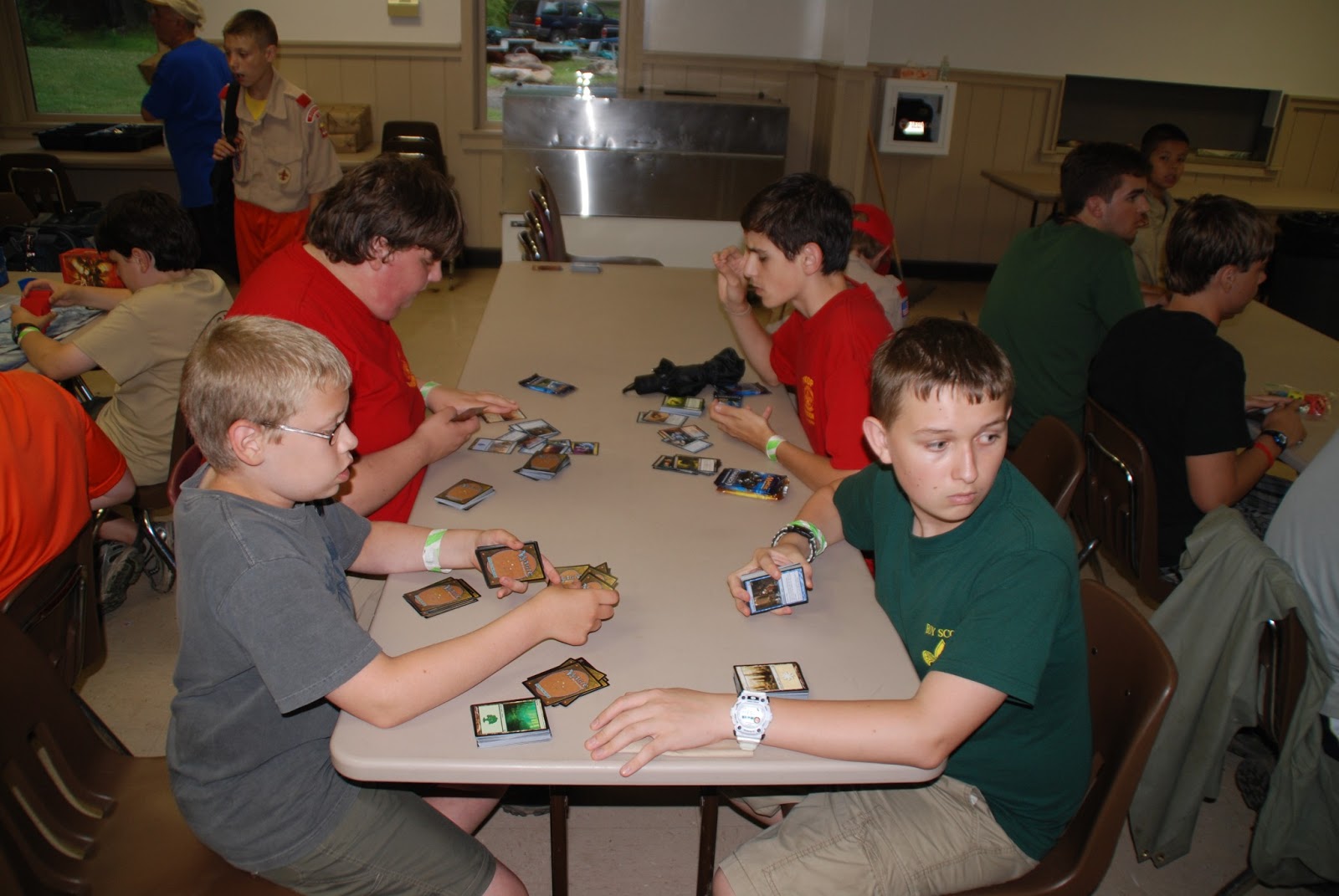
Across the nation, Scout Camps regularly host several hundred Scouts a week for between 4 to 8 weeks during the summer.   At these camps, bright Scouts who have picked up the game of Magic play between meals and classes at picnic tables.   They battle for honor and a bit of respect.   Yet at Ockanickon, there is a rather unique occurrence.   Once a week, campers battle it out in a special tournament sponsored on site.   It's the only time that I'm aware of that you can see a tournament attended exclusively by Boy Scouts.

A recently retired L2 judge by the name of Terry Robinson comes into camp with some boosters of Magic product and runs a highly customized MTG tournament out of Foster dining hall on the property.   Instead of random pick-up games, Scouts can come in and for a very reasonable fee either play in a constructed or a sealed tournament.   Because this is a Scout camp and things run on a stopwatch, there isn't much room for a tournament structure as you'd know it as found at a LGS or a GP.   One difference is players who play sealed only get five packs and 30 minutes to build.   All games are on a thirty minute clock.   And no matter how many players there are, he only runs three rounds total - a concession to the need to be done by 10pm, when Scouts have to be back at their campsites.


Photos of the half of the Dining Hall in use for Magic Night

Terry runs a very tight ship, and his experience shows it.   But don't let the short clock or limited sealed pool offerings fool you - Scouts know how to game under pressure and almost no one goes back to their tent unhappy.   While he is no longer a staff member of Ockanickon, his smile and presence is welcomed by all. Magic Night at Ockanickon is seen by many as the highlight of their summer camp experience.   When you offer a program as deep and varied as Ockanickon's, that is high praise.

The Game
This past Tuesday night, Terry was a little overwhelmed by the number of Scouts that showed up to play (along with a couple of leaders including myself).   He had 36 Scouts for constructed, 27 for sealed and a total of about 90 people in the room at any one time.   In a camp with about 500 campers, that's pretty significant.   Camp staff are allowed to participate, but only in the sealed pools.   Camp staff also helped him run the tables and performed setup, helping to get things running smoothly.


I entered to play sealed.   I figured my skills were best in that area, and I had no idea what weird meta-game I'd face in constructed with so many Scouts from Maryland, New York, New Jersey, and Pennsylvania playing.   My son, Jacob, originally thought to play constructed, but changed his mind at the last moment and entered into sealed with me.   We paid our $20 each, received our five packs and found a spot to start brewing.   Terry got things going immediately, once he had everyone into his database he started the clock on sealed deckbuilding and moved right into registering the entrants for constructed.

Jacob and I both started with 3 packs of Gatecrash and 2 of Dragon's Maze.   While he pulled a Ral Zarak, my best value card ended up being a Watery Grave.   Five packs total to pull from simplifies and complicates brewing.   It's almost a skill unto it's own.   For starters, the obvious thing is your pool is smaller, so it should take less time to evaluate what is good and what direction you need to go into for your build.   On the other hand though, your pool IS smaller.   Meaning you have to be a little bit more creative and you practically have to be in three colors (unless you get a nut draw like my first opponent did).

Son of Magic Dad, Jacob, with his intense game face.

Thirty minutes goes by fast!   But anyone who spends as much time as Jacob and I do drafting, we knew the clock would not be our friend and came up with something we felt we could play with that wouldn't completely embarrass us.   His deck ended up being a patriotic mash-up including: Boros Charm, Ral Zarek, Simic Manipulator, and a choice foil Lavinia of the Tenth.   While he only went 1-1-1, that was a strong enough showing to earn a pack of M13 with a Thragtusk inside.   He made back his entry fee in card value and overall was very pleased with himself.

Decks built and ready to play.

I on the other hand didn't fare so strongly in the rare department.   I ended up with a satisfactory Orzhov/Boros deck though, playing Skynight Legionnaire, Sepulchral Primordial, Warleader's Helix, Ripscale Predator, Weapon Surge (a wicked combat trick that won me a match), and three or four Extort creatures.   While I was fearful I would have an uphill battle, in the end I did well enough to end with a 2-1 finish.   My one loss was to a Scout that somehow pulled a nightmare combination of Selesnya cards - I don't think he could have done better with 8 packs to choose from.   My two packs worth of prizes did have some very playable cards, but nothing that is worth reporting as a return on value.

Turning them sideways!

The best part of the evening?   There wasn't just one.   Playing Scouts from other Troops and seeing the bond that is Magic pull Scouts together in a way that you normally only see when they are faced with a unique task was amazing.   Sitting across the table from a Scout no older than eleven and watching him strategize, while keeping a strong conversation going with an adult was well worth the price of admission.   Watching a number of Scouts from my Troop, who I had only taught how to play Magic a month ago play in their first organized event was priceless.   Even seeing the unique tournament structure that Terry has developed was worthwhile.   When the last match had been reported and the last prize had been given out, I sat down with the man who organizes this weekly tournament to talk about his thoughts on the game.

 Jacob, on the left, battling it out.

Two Scouts, Oliver and Cole, in their first organized play experience.

Meeting Terry
As mentioned, Terry is a recently retired L2.   His real life job as an Actuarial Analyst combined with the fact that these matches are unsanctioned contributes to his no longer being a certified judge.   But that hasn't diminished his love for the game, nor this desire to give back to Scouting.   He's been running tournaments at Ockanickon for 13 years, since Odyssey.    He seems to have it all down to a science.

Terry Robinson calling out pairings.
With a mounted deer head in the background.
Wearing sunglasses.
Your argument is invalid.

(Please bear with me, we had little time and I'm not a journalist by trade.   This ended up being more of a conversation than an interview.   If you've ever talked with him, you'll know that he's fast, smart, and able to leap tall buildings in a single thought.   I really should have recorded it, as I have no skill at shorthand).

Once we covered the preliminaries, my first question was about whether or not he had noticed any growth in the tournaments he runs at Ockanickon.   He was quick to reply that while there's a certain ebb and flow (noting Kamigawa as a lower point in participation), that numbers are definitely up this year.   That parallels what the larger tournament scene is experiencing.

He then jumped right into telling me about the format he uses and the challenges it represents.   When Jacob and I registered, we did present our DCI cards - only to be told the event was unsanctioned.   The format he uses isn't sanctioned by Wizards of the Coast because it's held on private property, thus not open to the public.  He spoke about the challenges of running events that fall outside of MTG's definition of a sanctioned tournament.   One of the biggest issues for him is it's harder to obtain certain product.   Terry mentioned that the most popular product he could sell would be Deck Building kits and other introductory level products, as many of his participants are brand new to the game - where one Scout goes, three other follow along just to see what the fuss is about.

How many Tournaments do you know start with the Scout Sign?

He then changed gears, wanting to accentuate the positive.  One area that he spoke very highly of was of the changes to the rules made in recent years.   While the Comprehensive Rules is still a scary document for some, he notes that the number of rulings he has to make - even at a large tournament of almost 70 players - really isn't more than one or two a night.   Terry expressed that the rules on the cards are so much more clearer than they used to be.

We didn't have much time, but there was one other thought that percolated to the top of our conversation.   Terry expressed that for many Scouts, this night would be the highlight of the week.   For many, this would be there first chance to play in any type of organized play.   Judging by the interactions I had earlier in the evening, I couldn't agree more.   Even lined up outside of the dining hall before gaining admittance, there was an energy to the crowd of Scouts that you don't find anywhere else in camp.   Terry may have been almost overwhelmed with the number of Scouts that showed up to play, but he wasn't going to allow a single one of them leave disappointed.   His prize structure is generous.   Even when Scouts don't win a pack though, the ability to hang out in air conditioning for a few hours of a very hot week can be prize enough.

Final Thoughts
The pairing of Scout camps with Magic - or any other collectible card or board game - seems to be a natural fit.   Scout camps are always looking for unique, fun, and challenging programs for their evenings.   Many fill these holes by offering a movie night or Troop swims at the pool.   But actually offering a mini-tournament using Terry's model is something that I'm surprised more camps don't try to adopt.   Obviously, you need an ambassador with Terry's love for Scouting and Magic to make it work.   You also need someplace on site to hold a tournament that is air-conditioned (humidity is not a friend to Magic cards).   Luckily, Ockanickon has such a place in their dining hall.

I'm paraphrasing some what Terry expressed in his conversation with me, as he thinks that Wizards should create a system that supports programs like the one he runs at Ockanickon.   Unsanctioned events shouldn't have to mean unsupported.   Scouts can have a tremendous organized play experience that is tailored to their needs with support from WotC.   The chance to sell product combined with introducing a legion of new fans to Magic seems like a win-win to me.   Terry obviously felt this way, or else he wouldn't give as much of his time as he does every summer.   So I offer it for consideration: an unsanctioned format, with custom match software, product support, and a registered judge to oversee the event.   Create a system by which product can be obtained that fits the demographic of new students to the game and sold to the Scouts attending.   With camps regularly seeing attendance numbers of over 200 Scouts a week, there is little to no reason why some creative marketing can't make this a more common occurrence.

Terry's thought on this extends to even having a flyer with a list of LGS's that are authorized re-sellers within a 50 or 100 mile radius of camp and how to register for a DCI #.   This would offer Scouts a starting point after they go home at the end of the week to continue playing and building their collections.   People like Terry, who run events of this nature should be able to obtain product and become and authorized reseller with little fuss.    There may be a few naysayers that see this as potentially cutting into their profits.   To be honest, every single one of them should be thankful that in at least one instance, there exists a man like Terry to introduce new generations to Magic, one sweltering week of summer camp at a time.

Here's one more reason to offer more support to people like Terry offering unsanctioned events.   If you were to stop by the Trading Post at Ockanickon during the day, you'd see that they sell boosters, playmats and other gaming supplies in addition to flashlights and hammocks.   Aside from the slushies on a hot day, I didn't see anything more popular in the store than the Magic cards.   It's a phenomenon, and I can't think of a better way to help capitalize on it than to promote the work being done by Terry and helping him to better serve the community.   What works at Ockanickon can be adopted elsewhere with some clever marketing.   With the recent creation of the Game Design MB, there is also hope that a formal agreement can be made at some point in the future with the Boy Scouts of America.

Victor, who only learned to play less than 20 days ago in his first tournament!

And that friends, would be a great day indeed.   Fresh faces, brought up to be respectful and follow the Scout Oath and Law, would create a whole new generation of players.   The perfect match of a quality organized play experience with new people to play the game.


More photos:


Afterword: Neshaminy
Here's my list of the top 10 translations of the Lenni Lenape word for our campsite at Ockanickon.   For those that have camped there in extremely wet conditions, actually for Boy Scouts in general, this should be a good bit of fun.   Everyone else, thanks for reading my article and I hope you have a great week!

10. No Lifeguard on Duty
9. Good Fishing Grounds
8. Bathing Attire Required
7. Land of the Longboat
6. Just Add Water
5. Muddy Swimming Hole
4. Campsite That Will Not Drain
3. Home of the Wet Sneakers
2. Wooded Home Surrounded by Frogs (you had to be there)
1. Birthplace of the Muddy Slip-and-Slide

The actual translation for Neshaminy is believed to be - "Place where we drink twice."   I think that is an incorrect translation.  It should be, "Place where we were dunked twice."   Long story behind that one.   Seriously, it's all in good fun, we had a great week there and I hope Troop 94 will choose to return to Ockanickon.   Thanks go out to Bill and his camp staff for making the week memorable.
____________________________________

Reblogs & Retweets & Mentions of all kinds are appreciated - as an independent writer I'm only read when others like what they see and share with their friends.

Photo credits: Christina Preissman, Charles Featherer, Ed Heierbacher (Ockanickon Staff)

Tuesday, June 25, 2013

Great Job, Tim!

This week, I have to give some serious credit where credit is due.

I can pretty easily imagine what goes into making a standard GP or similar event happen.   Physical arrangements, judges, materials/supplies, guests, vendors, VIPs, artists, and more must all come together in perfect harmony to make the event seamless to the participant.   These events, while pretty pat do run into problems occasionally, especially when more than the expected number of participants show up to sling spells.

In the days running up to GP Vegas, the number of preregistrations coming in was astonishing.   I (and many others) made predictions months ago in the 2-3,000 participant range.   Twitter was afire in the final two weeks of preregistration, as it suddenly seemed possible to smash the previously held record for a TCG event.   In the final days leading up to the GP, it became clear that 4,000 to 5,000 or even more participants would be possible.

And what was better is the Tournament Organizer (TO) for the event, Tim Shields, came out on his blog in the early part of the week before GP Vegas and said that he was ready for up to 6,000 or more.

Let that sink in for a moment.   6,000 or more people playing Magic the Gathering in one place at one time.

Over the next two days though, Tim had to step back, reevaluate and change his tune.   Was he right?

Logistics, Logistics, Logistics
It's a well known idea that an army is only as strong as it's supply chain.   No food?   Soldiers don't fight.   No fuel?   Vehicles don't move.   Planning and running a GP of any scale works on many of the same principles.   TO's must find enough qualified judges, space for the mobs, and enough tablecloths for all of their tables.  They have to worry about every little detail.

Following Tim's announcement via his blog that all was well, the next day another blog post came out.   And things were no longer perfect.   He discovered at least one problem to running an event of this size...human error.   It wasn't his error.   It was the approximately 10% of errors made by players when entering their DCI # for registration (note to WotC - is there some way to make the preregistration process validate name/DCI # for prereg??).   In combination with some qualified individuals, Tim Shields made what I know was a tough decision - he capped the event.  And he was right to do so.

No longer would he have to worry about 6,000 or more of his closest friends showing up to party in Vegas. Now, he just had to make things work for the 4,500 that would officially play in the GP as well as assorted guests and those that would arrive to participate in side-events.

Even as D-Day drew closer, it became clear that capping the event was a good idea from other logistical angles.   Last minute calls to judges were made.   Lines of up to 2 hours or more were heard of on Friday.   People waiting from approximately 3am on Friday morning to get one of the last 100 spots.   And we won't even mention the little snafu with product that was a little behind schedule to be delivered.

I Told You...ah, Forget It
It's not worth saying, but I saw this coming.   A GP with 3,000+ participants?   Absolutely possible, and with the popularity of the Modern Masters product, almost a given.   The only question was, would enough people travel at least 200 miles or more to make it a success?

Buried in my feedback for my first Blog posting here as Magic Dad, was a great letter from a TO of some renown    In the letter, the gentlemen who we'll refer to as 'TS' wrote that he appreciated much of what was said and that he is striving to avoid mistakes in the future as a TO.   He talked a bit about what preregistration numbers meant to the final tally - how does one predict attendance based upon prereg numbers was a central theme.   As TS closed his letter, he said, "...I understand that we need to get way better at running complex events as these things go from 500 players at a GP to the 5000 person GP of my dreams."   Wow.

Is Tim...err, TS...precognitive? 

Bitter Pill
It is a bitter pill to swallow, making last minute changes to an event that will shut out some players.   It's even harder to do when you strongly believe in your event and offering the best service possible.   But Tim showed some great character in doing so.   It wasn't an event I was going to be at either way, (I'm on the east coast and traveling to a MTG event more than 2-3 hours isn't something my wife really...understands).   If I could have gone, because I had to make arrangements in advance I would have absolutely included preregistering.

In fact, I'd likely do so at least a month or more out from the event.

So why didn't everyone else?   Why is it that even in the last week, Tim took on 1,500 more registrants?   A full 1/3 of the people attending?   Didn't they know they were going to go?

Let me ask this another way.   You  want to attend a concert to see your favorite band.   Mine is Metallica, so I'll go with that for this example.   To get into a venue with limited seating and to participate in a popular event, you plan in advance.   You schedule time off from work, just to buy tickets.   When they open up ticket sales, you jump online, sweating bullets (sorry, wrong band) that you'll not get the seats you want.   Or worse yet, that they'll sell out in 10 minutes and your transaction will take 12 to complete.   A 60,000 seat stadium can be sold out in less than 30 minutes.   Why is this so different than an MTG tournament?   MTG GPs don't have unlimited resources.   Both gamers and TOs recognize this.

Granted, I don't think I'll get to see Kirk Hammett at a GP, but still...

The point I'd like to make is, Tim made a tough decision.   But he did so knowing several things.   He knew that he had offered preregistration for some time, and that dedicated players had already registered.   He knew that he would still keep it open for another day or three, depending on how many signed up.   Tim tried to make the event as accessible as possible to all players, but he knew that issuing a cap was the right thing to do when faced with the alternative.   He had to choose between disappointing players who didn't plan things out with disappointing players who had planned and payed for the privilege of attending.   You can do the math on that equation a hundred different ways - but every time I do it I come up with Tim's answer to the problem.

One Step at a Time
Tim Shields is a TO who made the right decision in a difficult situation.   He ran an event that many reported to be smooth and without any major problems on a scale never before seen in the MTG community.   He did it by planning far in advance and working his plan.   Yes, he did make a mistake in projecting the human error component (if you can call it his fault people make mistakes).   He offered heartfelt apologies for this.

He also made some improvements to the experience for players, by offering and promoting preregistration as the best way to get a seat at the table.   If we all learn one lesson from this, it's this: Preregistration Works.   I don't want to call it a done deal yet, but I do foresee the next change to MTG events being preregistration is the only way to register for larger events.   To make it really work, you have to do two things though.

First, you should find an incentive for preregistration that encourages players to use this process.   Either a choice product (a special token, playmat or other game gear) or a discount.   I'm not talking to TO's that do this already.   Those that don't need to find a way to sweeten the pot, just a little bit.

The other thing you must do is learn from Tim's one or two miscalculations for this event.   I think it's not unreasonable to state that you need to place an absolute upper limit on the number of registrations you're willing to accept, based on your capabilities to host the event.   Tim did do this, it just ended up being that he had to make a late adjustment based on new information.   Remember, there are only 40,000 seats for that Metallica concert - just as there are only so many judges, lands, or tables available.   Please don't state you can handle X number of players when there is a limiting factor that says the real number is X-500.   I'm not faulting Tim Shields here, but I am stating that his experience is one that all TO's can learn from to provide even better service in the future as GPs continue to increase in size.

Applause
So let's do this.   Everyone who attended the GP in Vegas should send Tim a message via Twitter (@timothypshields), thanking him for the event.   Even if you tilted horribly and dropped day one, recognize that organizing an event of this magnitude and running it as well as he did deserves some special recognition.   When you see a Judge, thank them as well - they helped to make the event what it was.   I'd encourage everyone to thank special people at WotC as well, but don't forget to show Helene Bergeot some love as well via Twitter (@helenebergeot), I understand this event fell largely into her domain.

While we're on the topic thanking people, remember to thank your LGS for supporting the game and giving you a chance to draft or play in a format.   The support for GP's like Vegas really starts there.

When you're done thanking everyone, you can go back to the debate of the day on Twitter or Reddit.   But only once you've made sure to thank these awesome people for helping you set a record and attend an event that was, by all accounts, executed without any major problems or delays.   That, my friends, is a miracle.


Wednesday, June 19, 2013

Getting Committed

I'm a person that enjoys writing.   It helps me to exercise my demons.   Even the nasty little blue ones with sharp pointy teeth can be driven out with a good session with a word processor.   The mere act of putting something onto the screen helps to remove angst and feelings that are bottled up inside of me.   I'm also a voracious reader, but the act of reading is fundamentally different than writing.   With reading, we consume and ingest someone else's works.   We enter their world and are trapped in it for a time.   By writing, I have the ability to give weight to the many ideas that roll around inside of my head like a sea of chaff.   I can distill my thoughts down to 26 characters arranged in a fashion to convey love and hate, joy and sadness.   It's a wonderful feeling to get all of these random thoughts that bounce around my head down in some permanent form that others can read and comment upon.

Writing, to borrow a rather trite expression, is a cathartic exercise.   The act allows me to wrestle with concepts and free them to the world.   But there are dangers in writing.   While sitting at a desk in some anonymous residence, I'm invincible.   I can slay dragons and rescue damsels.   Or rescue dragons and slay damsels, such is the power of the word.   The minute I select to publish though, it's free.   Free for consumption.   Free for interpretation.   Free for criticism.   Free for distribution.   Just as the act of writing is freeing, the act of reading is the opposite.   People are incarcerated by things written by not just me (poor, lowly me) but by thousands of pundits, reporters, and authors across the many mediums that allow print to be given unto life.   The act of publishing a written work puts it in the public domain for review, trapping the reader in the writer's interpretation of events.   What is more scary though is it traps the writer into the reader's ability to interpret the intention of the piece.   Be it a Twitter post or a 1,000 page novel, the writer is as trapped as the reader until the journey is complete.

All of that doom and gloom aside, I hold a neutral view regarding the publishing of things I write.   I can't always make people see things the way I see them.   I am as open to be being misinterpreted as any other writer.   Sometimes, that causes me discomfort.   I want others to accept what I believe are rational arguments.   I want others to feel the emotion I express.   It's not always the case though.   There is something I find more dangerous though than writing a viewpoint and having it misinterpreted.   It's the act of writing something personal as a declaration of self improvement.   Stating, "I'm going to learn how to rebuild a car engine," is limiting myself to a particular act.   What if I fail?   What if I can't figure out how to time a carburetor or misunderstand how to use a torque wrench?   The act of placing a promissory statement in regards to self improvement is one I've often shied away from because of how limiting it can be.   It places handcuffs on my wrists that can't be removed when the readers stop reading - because I know I wrote it and it's out there.   It's a trap within a trap.   Today though, I'm going to make a statement regarding self-improvement as it relates to Magic.   And I want to challenge others to do the same.

Kitchen Table
We all play MTG in a variety of formats.   Some of us like EDH but hate limited and cube.   Others of us only play casual Magic, mixing things up over the kitchen table until we reach wild board states WotC never thought possible.   I've professed my own love over playing limited and my personal confusion at the Standard meta game.   You might think that's bonkers, that the only way to play is Standard, or Modern or Vintage (let's not even talk about Extended, perhaps the most unsupported format in the community).

No matter what format we choose to play, we all do so with a passion.   I've recently expanded my repertoire using EDH and my box of Modern Masters as a springboard.   No matter what I play, I find an increasing love for the game every time I pick up a deck and roll dice for turn.   One thing continually strikes me though.   If I don't have Larry around (my LGS's local rules guru), I feel like I'm flying blind.   I 'know' how some cards are supposed to work with others.   I'm particularly comfortable playing the newer blocks and formats.   EDH and Modern Masters has opened my eyes a bit more to the wider world of card interactions.   Splicing, for instance, is insanely cool but a little bit complicated.   While I have moments when I feel stupid, that doesn't mean I feel good when it happens in the pursuit of new formats and game styles.

I want to understand how the stack works.   I need to know how to work out complicated layers questions. I've want to grok who has priority in any given situation and what to do with the new legend's rule.   So it's time to graduate from Kitchen Table Magic.

Judge!
I've been impressed at all levels with the Magic Judges I've seen and interacted with at events.   I consider them a class above the rest.   I've decided (and this has been on my mind a great deal lately), that I want to be a Magic Judge.   Cue the Rocky music.   Cut to the training montage.   Just don't do a head-shot - I'm not Hollywood material.   Perhaps we could get someone like Brad Pitt to play me...   Oops, sorry.  I drifted off topic for a moment there.

I know there are people out there that will help me with this endeavor (Rocky music slowly rises in the background again).   I'm not sure at the LGS level how that will work out, but I do have a friend who has already offered to help me in this endeavor from a store about an hour away.   I've got a few reasons why I want to do this, some are more personal than others.   But I think it's important to try to share them here.   If I'm going to go all in, I may as well do it with some style.

My first reason is simple.   Please don't gasp when I state it out loud - you'll wake the baby.   Folks, Magic isn't cheap.   There's a reason people call the game cardboard crack.   As a hobby just for myself, it would be one thing.   But I've got a 12 year old in tow everywhere I go that wants to do what I do (and vice versa, to be fair).   Every time I pay for a draft, I'm paying double.   Every time I pay an entry fee?  Double.   Food?  Double.   Come on and sing it with me, Double, Double, Double...   Long term, there are two sustainable models.   Actually, there are three if we count the lottery.   But the hard truth is that I can choose to either play a lot less and not take Jacob to as many events and FNMs or I can work on becoming a Judge, thus helping to lower my costs over time through participating on a different level than as a player.

Finances though aren't the only reason.   If it were, it wouldn't be enough.   I'm a firm believer in service to organizations I care about.   I see Magic as not being much different than Boy Scouts in that regard.   As a leader in Boy Scouts, I've got 14+ years of volunteer experience.   Giving back to help something grow into something better for tomorrow is a worthwhile goal.   Combined with my time in a field of work that relies on customer service, I'm sure the combination of wanting to give back and serving others will work well for me as a judge.   I know donning those black threads is something many experienced players can and should do.   I also realize that not everyone has the ability to deal with someone that has just lost a significant decision.   I'm positive though that I have a pedigree of experiences from my vocation that will serve me well as a judge.

My last reason is perhaps the most selfish.   It's also the reason I imagine many others get into this side of Magic.   I want to better understand the rules.   I don't want to do this to know how to bend them, I want to do this so I know when others are doing so.   I trust a great deal in what my opponents tell me about their board states, as I am often more concerned with mine.   However, the comprehensive rules for Magic are several hundred pages long (I know, as a player I've already read them twice).   To really understand how something on page 56 interacts with something on page 211 is still a mystery to me.   I want to know how to read and interpret the layer upon layer of complexity that powers the MTG engine.   I'm sure I can do it, but without a goal beyond my kitchen table, why would I bother?

Commitment
I'm setting a goal for myself that is quite frankly a bit daunting.   I know that the rules and interactions are complex.   I also know I'm committing myself to a serious goal here by simply putting this down for others to read.   No longer will this be something, "I'd like to do."   Now it is something I will do.   No more lurking in the Judge Tutoring Facebook page for me.   From now own, I'll take a crack as I have time at answering questions.   I'll open up the Comprehensive Rules and start reading through them again.   I'll reach out to my friend (Judge and TO Nick Coss) and ask him how to move forward with learning some of the more complex interactions - or better yet, when I can next come to his store to help out with an event.

It won't be easy.   The hardest part will be the time commitment as I work full-time, volunteer several hours most weeks with Scouts, and I'm a college student as well - kids, finish your degrees when you're young.   But I will do it.

I'll take the black.

[Cue crescendo, ascend steps of staircase in front of Philadelphia Museum of Art, raise hands in air and fade to black.]

__________________________________
This story has been sitting in my list of ideas and stories for over a week.   To be honest, I'm scared of making this type of a commitment - or rather, to make it as a public declaration.   I almost didn't post it.   But I want to see others step up to the challenge.   So I hit the publish button.   I'm not asking for blood, just a little bit of your time if you read this.   Consider what you can give back to the game.   If you don't want to be a Judge, find some way to give back.   The game will be better for it.

Thursday, June 6, 2013

Five Things I Think...

Today, here are 5 things I think I know about MTG:

1. Modern Masters: This special set will be a smashing success.   Wizards will make money, LGSs will make money, traders and the secondary markets will make money.   No cards will go down overly much in value, in fact most should remain at their value or spike slightly in price.   I do not think it will have the intended affect Wizards of the Coast hopes for - at least not to the scale that they desire to see Modern become an increasingly popular format.   They'll learn lessons from this release, and likely have a MM2 within two to three years.   (I strongly disagree with anyone that thinks it will happen next year - to the point that I'd put money on it).

I've already written why I think this set will have problems fulfilling the expectations of WotC, but here it is again in a nutshell.   The overall cost of the product, often highly inflated above the suggested price, is a big red stop sign to many players.   If you're not going to GP Vegas (can you say 3,000+ guests?), than you're likely going to be paying at least $200, and more likely $250 or more for a box.   For those that get it below $200, congrats.   However, all that aside this will be phenomenally successful.

2. Modern Masters (Part Two): I am excited to get my box at the MSRP - thank you Top Deck Games.   I can't wait to open it.   What I am having a hard time deciding is in advance is what to do if I hit a few money cards.   Trade them back and buy another box?   I think that's the move, but I honestly don't know.   I do turn a little bit into Gollum when I think of foil 'goyfs and swords.   My precious...

My ultimate goal is I want to be able to build a couple of fun Modern format decks.   I don't expect my Modern constructed deck to be competitive.   Yes, even though that last statement sounded counter-intuitive I do mean it exactly as I said it.   Is there a player of Modern out there that isn't a Spike and doesn't just want to smash face?

I don't, at least not in constructed.   In constructed, I'd rather learn how to play.   I want to have a good time.   I'd even like to have a conversation with my opponent before and after the game.   In Limited format, I'd absolutely like a little bit of face smashing.   But I'll be lucky to draft this in a group more than 2-3 times.   It's a big set with a high learning curve for people that have been playing as long as I have and it's expensive.   Even if you can find a draft where they aren't charging much more than MSRP, unless you're independently wealthy you likely aren't drafting it much.

I'm anxious to hear about people's experiences with this new format, and I will try to write about mine if they're exciting enough.

3. EDH: I think that by the end of the year, we'll have 4-6 new EDH products from WotC.   This is a best guess, but I really do feel that with the increasing popularity of EDH as a format and given the initial overtures by Wizards were very successful, they can't help but follow-up with another run of custom decks.   Two things would make this even better - one, each deck has a chance for a bonus commander and two, there will be at least one new card for each deck that will only be available to EDH players.

I'm also finally playing my EDH deck I built a couple of months ago.   This may sound blasphemous to some of you, but I can't tell you how much more fun it is to play than my Standard deck.   I can't get enough of it.   My general is Aurelia, and while I rarely get her to the battlefield against my son's Ruric Thar deck, when I do it's glorious.   I practically thump my chest when it happens.   As an aside here, for a little dude that's probably spent less time building his EDH deck than he has reading the rules, his deck is always a handful.   My deck is a study in what I have versus/what I can afford/versus what advice I've received - in theory it should be leaps and bounds ahead.   Yet he constantly finds ways to beat me.   I don't know if I want to start tinkering with my deck yet.   Perhaps it's time to start building another one?

4. Drafting Nightmares: I know I practically wake up with cold sweats now the night before a block draft.   It's just that scary.   I've played it 4-5 times.   I've read just about every article out there.   And I've really thought I've been smart, or clever, or strategic or ... [insert your favorite synonym for intelligence here].   I haven't broken 3-2 yet.   Last week I went 1-2 with what I thought was a pretty vicious Gruul splash black deck.   That's not so bad, at least I'm above 50% overall, right?   For someone who's still a drafting infant compared to some of the weekly competition, isn't that respectable?

Unfortunately, it's not for me.   Here's why.   I'm not comfortable.   Let me break it down for you, so we can all look at it.   It starts with Pack 1.   Dragon's Maze.   10 Guilds, one Pack, few common playable cards, maybe.    Questions about whether or not you have to telegraph what guild you want/need to be in and which pack that is.   Tough choices among the uncommons and rares abound.   Do you choose that Orzhov card, or do you go with the Gruul?   Gold card or standard?   Draft gates early or late?   There are as many strategies as their are guilds - actually, there are more.   The funny thing is, this set is so well balanced that it depends more on your bombs, removal and play style than it does on what guild you draft - at least, as far as I can tell.   (Noted exception, Dimir is still difficult to play well).

And there are at least six players at your table (hopefully eight or more).   This isn't your mother's M13 draft.   Oh no sir, this is a whole different animal.

So you pick likely 3 colors out of Dragon's Maze.   Maybe you splash a few gates to help you on your way.   Then you start up with Gatecrash followed by RTR.   The second two packs of this block are where things get dicey.   Why?   You guessed wrong.   Either someone to your right or left starts cutting you at a critical time.   Or what's worse, because there is only one set of packs instead of three that server your guild, you don't find any fixing.

I spoke with a friend at last week's draft.   I asked him what his impression was after having been able to draft it a few times more than I had - and I don't think he had any better feel for it than I did.   Of course, he beat me pretty soundly later on in the evening, but I don't think he knew why his deck worked anymore than why mine failed.

I'm a self diagnosed Timmy - but I like to at least understand and plan a bit of what I'm doing.   This limited format is crazy.   Not necessarily in a bad way, but it is crazy.   So here's what I think.

I think that TO's and LGS's should find a way to order and store a fair bit of RTR, GTC and DGM stock.   Anything less than 5-10 full cycles is ridiculously near-sighted for any store with a dedicated base of players.   When this format goes out of rotation, it will be a drafting gold standard for years to come.

5. Vintage: Lastly, I think I wished I played Vintage.   I wish so much for that depth of knowledge of the game and for the cards to play at that level.   I want to be able to do this.   To be able to play at my friend's coolest Magic event of the year and feel like I belong.

But here's the thing that I've learned about Magic.   I don't have to play Vintage to attend the tournament.   I don't have to even know what it is.   I just have to love the game.

And because my friend is the TO, I know something else.   I'm saving the date.   Not because he's my friend, although for me that would be enough.   No, it's because he knows Magic.  It will be worth the drive just to see the side events, the people, the artists and the product.   I fully expect we'll get to play some fun drafts.   I hope to get to spend time meeting some great people and talking with them.   Perhaps above all else, I can't wait to be introduced to what it means to play Vintage, and to share that with my son.

Jacob and I will be there in November, and we'll bring our decks, binders and a great attitude.   Perhaps we'll even bring some SJ attitude with us.

November 1-3, Philadelphia.   Be there folks, for the return of the Eternal Weekend.   Maybe together, we can figure out what an 'eternal weekend' is and how we can make more of them.   Hosted by Card Titan, it will be an event to remember.   I can guarantee you that.


As always, feedback is appreciated and sharing it via Twitter/Facebook/Tumblr is even better.   Being an independent blogger, if you don't help me share this, it doesn't get read.   I don't charge or advertise, so if you enjoy this help me by spreading the good word.

Thank you for reading!

Thursday, May 30, 2013

Magical Boy Scouts

Three months ago, the Boy Scouts of America introduced a new merit badge to their constellation.   Scouts would now have a chance to learn the principles of Game Design from qualified counselors.   I'm a volunteer adult leader in Boys Scouts in addition to being a father, gamer, and all around swell guy (alright, the last bit may be fiction, as I have no one that can confirm or deny it).   I have to say that the gamer portion of my brain went into overdrive when I heard about it.   Before the actual launch date, I had put into my local Council to be a counselor.

The BSA recognizes that the theory that goes into creating a game is a teachable and worthwhile skill for Scouts to learn.   All Scouts who wish to take the merit badge have to complete eight different requirements, several of them with multiple steps.   The general idea behind merit badges is to allow Boy Scouts to learn new and interesting hobbies, fields of study and even vocations.   Perhaps one day a Scout that I teach could go on to be a professional public speaker, enjoy kayaking as a lifetime pursuit, or even become a designer of a game loved by millions.

About a month ago, I received word that I could teach the newest offering of the Boy Scouts.   I was an official counselor of the newest Merit Badge offered by the Boy Scouts.   In order to teach the class though, I had to come up with a plan.

Relationships
Before teaching the class, I had a few details to work out.   I had to decide if I should teach it upon request (which is fairly common) or if I should teach it using a classroom method.   The benefits of teaching this particular merit badge - let's just call it an MB for now on - in a class far outweighed teaching it one-on-one.   I consider the best games to be those that encourage some type of interaction between players.   The next decision to resolve was where to teach it.   I had several options.   I could teach it out of my home, at the meeting place my Troop uses, or at some other suitable location.   The place obviously had to have tables and chairs, decent lighting, and room for up to twelve boys plus myself.   Once I thought of it that way, the choice became obvious.   My local game store had an ideal space - but would they want us there?

A quick conversation during MTG league play on a Sunday afternoon let me know I had the right idea.   The new co-owner of the store was immediately excited.   He asked me to put something together and send it in to him as soon as I could.   Within a few weeks, I had sent in an outline for two different versions of the class along with pricing, expected turn-out and a brief outline of what I wanted to teach and what I needed help with teaching.

After a few more such communications, we had a date, a plan and a few ideas for expanding the program at a later date.   The most important part of setting this up was to pick a date and time that worked for both parties.   I couldn't do it too early on a weekday, kids are in school and parents are in work.   Weekends for the store wasn't a good solution, as they they are often very busy with tourneys.   So we had to strike a balance.   In picking a Thursday night, the LGS and I were both satisfied.

When I set this up, I knew I had a few goals.   There were in order of importance: introduce the Scouts to the MB, teach them a new game, introduce them (and their parents) to the LGS, generate new customers for the LGS.   Why was generating new customers a goal?   Simple enough.   I wanted to be a good steward.   Call it a fringe benefit, getting kids into the store that had never been there before would hopefully result in new customers and repeat visits.   It's a match that will help the LGS and will benefit me long term as I build a better relationship with the owners to continue to host classes.

Keeping it Familiar
The very first time you teach someone any skill that you've never taught before, there are steps you should take to make things easier for you.   To make things easier for me, I had elected to keep the group small.   I originally only allowed 10 Scouts to sign up - and due to conflicts only 9 actually made it.   Of the nine, seven had never played a game of MTG before in their life, although several had played other trading card games.   Another way to keep it friendly was for this class I used my extended family for the inaugural class.   My Troop has about 40 Scouts.   This gave me a ready pool of Scouts that I was already familiar with to offer the class to.   That's a big plus when it comes to interactions and pairings for a one versus one game.

I also had a well-defined plan for the class worked out in advance.   I knew I had to go over several specific topics, and I had them mapped out in an order that made sense to me.   My smartest move was I enlisted the aid of someone who knew the game well enough to patiently teach it and offer guidance to new students of the game.   My ace in the hole was my younger son, Jacob.   At only 12 years old, he's a year ahead of some of the younger Scouts and has held a couple of youth leadership positions - plus, he's been playing MTG for a year and a half in various settings from casual to limited to competitive standard.   I have to state that without Jake, the night would have certainly been more stressful.

My helper, explaining to another Scout a finer point of the rules.

Lastly, to teach anyone a new skill from scratch it helps to have a model for teaching.   In the Boy Scouts, we use the EDGE method.   EDGE is an acronym for: Explain, Demonstrate, Guide, & Enable.  This model parallels how we learn something new in the best and easiest to understand manner.   The EDGE method is just a more formal way of looking at this.   By following EDGE, I knew we'd be fine.

Teaching Game Design
Confession time - I'm not a game design professional.   *GASP*   But, I do have a love for games from the simplest to the most complex.   I've played good games.   I've played some very bad games.   And I've even played a fair number of games that were simply missing something.   My particular experience is wide ranging.   From field games such as soccer and lacrosse which I've spent half a lifetime playing to word games, if it's interested me in some way, I've likely either played it or have been a spectator with an active interest.   For a long time, computer games occupied hours of each day.   Diablo, Quake, Descent, Baldur's Gate, Metroid...the list goes on for some time.   So how does one teach Scouts to design a game?

Ask yourself, what did I enjoy about any one game and you're off to a good start.   People play games because they challenge or divert you in some way you find entertaining.   Designing a game is the art of looking at what experiences you've enjoyed in the past and figuring out a way to capitalize on them in a fun and meaningful manner.   The MB takes these many experiences into account, and starts with laying some very important groundwork.

Last Thursday night, I had a chance to impress these core ideals in a group of young minds.   After all the Scouts arrived and made themselves comfortable, we started.   I asked Scouts take turns talking about four different games they've played and analyze them.   Their analysis covered basic building blocks of game theory, such as medium, format, objectives, rules, resources and theme.   Every game has at least 4 of these, most that have been professionally developed and sold have all six.   Once they expressed a baseline for what requirements go into making a game, then they move onto learning some very important terms used to describe games.   Some of the answers were interesting and led to brief side conversations.   I made sure to stress some concepts that I considered important.   First, while I considered Minecraft to be a game (some of the Scouts didn't), I made no such provisions for Candyland.   The other important point I tried to drive home during this discussion was the difference between official rules and 'house' rules.   I told them that house rules are just as important, but if you have to play the game purely as designed, it's important to understand the official rules.

Scouts were asked to define thematic elements such as story, setting and characters.   They're asked to explain play sequence, level design and interface design.   There are almost 20 different terms that they have to understand before moving forward from this point.   While learning vocabulary is hardly exciting, gripping stuff, it is required to progress.   One can possibly build a desk without knowing how to define a hammer, screwdriver or how to put Part A into Part B.   But to really understand the process, you have to know how to define and use the terms.   Having a conversation about designing a game forces Scouts to look at games they've played in the past in a more top-down view.   No longer are they the consumers and end users.   Now, they take on the role of the creator.

Before we moved into the really exciting material, we had to cover one more area of study in relation to designing games.   Possibly the driest of topics that would only excite a lawyer, those earning the MB must spend a little time learning about intellectual property.   Scouts may not realize it, but the lessons learned hear can be well extended beyond Game Design.   Hopefully, they gained something from the examples of what is and isn't a licensed property.

Teaching Magic
So the Scouts have had a taste of what it means to be a designer.   They've learned some new terms and have had a chance to listen to me wax poetical about the finer points of trademark law (actually, we keep this part very simple - it's not quite poetry to an eleven year old).

What's next?   Let's crack a pack!

To earn this MB, Scouts have to play a game.   The game has to be variables that can be introduced.   It can be a game they've played before, but I wanted to offer something new to many of them.   While I knew that two of the nine Scouts had some experience before with MTG, I knew that there was at least one format they've likely never played.   Working with the local game store, I had made arrangements in advance to have two packs of M13 per participant waiting in advance for me.   I decided that it would be fun to use one pack per person to run a Mini-masters, and then offer the second pack for each Scout as a item to take home with them and open on their own time.

As we finished up going over Intellectual Property, I was pulling out my mono-red standard deck.   Jacob was doing the same with his janky blue-black Stuffy Doll deck (don't ask, but I will qualify this with he's finished in the Top-8 at a PTQ with it).   Using our two decks, we briefly explained the game, from drawing your hand, playing land and on to the first few plays of a game.   I showed the Scouts the different parts of a card, from name to power and toughness.   We also went over life totals and different card types.   It was a whirlwind tour of how to play the game that lasted all of eight minutes.   I do talk fast, but I didn't want to take too long belaboring any one point.   I wanted to get them playing

The next move was to distribute their packs.   Each Scout opened their pack of M13 as per my instructions, discarding the cards that were unnecessary (the extra land and token cards).   Leaving the deck face down, we passed around the holiest of holy LGS game store relics, the 'bin-o-lands'.   Instructing them to take three of each land type, we soon had them shuffling.   As soon as they were ready, I passed out six-sided dice to determine who would get to decide who could decide as to which player would draw or play.   Before I knew it, I had all of them playing MTG.   And it was good.

An older Scout showing what it means to turn cards sideways.

The Scouts were lined up so they faced their opponents down the length of three tables (graciously set up in advance by the LGS with chairs and reserved for our use).   Jacob took one side of the table, I took the other.   As this was both meant to be both friendly and a teaching environment, occasionally he'd outright make play recommendations.   Sometimes I stopped play to get everyone's attention regarding a gamestate (mostly to explain common evergreen keywords such as lifelink).   At the end of the first round of games, I changed the rules.   Feeling that they knew what they were doing at this point, I introduced a couple of new wrinkles.   The first thing I did was paired up Scouts on either side of the table - the next round would be 2HG.   I knew that this would be a more complicated, but I had faith the pay-off would be worth it.   Scouts learn to work together under difficult circumstances.   Knowing how bright the boys were and they're naturally proclivity to work together made the decision easy for me.   The added benefit if having them help each other how to play while limiting the number of shoulders Jacob or I had to watch over made it a no-brainer for me.

The other change we introduced was one I had prepared for in advance.   Not all packs of a core set are created equal.   No one really expects to play well with just what you can open in a single pack, as balancing issues are sure to come up.   Either the pack could be heavier in instants and sorceries or it could have a larger number of low cost or high cost cards was something I knew going into this.   So I took a simple precaution.   Out of my stockpile at home, I had grabbed a dozen or so low cost, big pay off creatures to bring with me.   Flyers, haste and protection type creatures featured heavily.   Before they started their 2HG round, I shuffled the cards I brought with me and gave out one per Scout.   In hindsight, I did one thing wrong here.   I should have loaded them up with two or three creatures each at this step.   Teaching is about learning though, as much for me as for the Scouts.   Future classes will incorporate this idea.

With the changes in effect, we launched straight into another round.   The games took a little bit longer than before, but the Scouts adapted well to the change.   Before I knew it, my help was no longer really necessary.   They were plotting strategies and working out the best way to approach difficult problems presented by their opponents.   It really was amazing to watch them enjoy playing a game I've spent so much time learning in the past year and a half.

Winning
It's hard to actually capture for you all of the little victories that evening.   One that I remember distinctly was one Scout playing a creature during his first main phase.   It wasn't that he played it for the right cost (he did).   It wasn't that he played it at the exact time he needed it.   No...it was as he played it, he said, "I summon..."   Wow.   Future Vorthos player right there.

Now that I think about it though, there were nine victories that day.   Not all the Scouts found themselves in a winning position.   Not all of them opened up a pack for a choice rare.   All of them did learn a new game (or a new format) and every last one of them left that night smiling.    Before they did though, I handed them two packets and their second pack of M13.   The first is packet is one I provide most Scouts when they take a class I teach.   It's a workbook that will help to guide them in the next steps they have to take to finish the class.   The other packet had a pair of articles written by the maven of game design, Mark Rosewater.

In setting up for the class, I figured I could find a good article or two by Mark on the topic.   Author of some ridiculous number of articles on Daily MTG, I went to my dear friend Google and asked it to search, "Magic the Gathering Game Design".   It set me on the path to this pair of articles:

Ten Things Every Game Needs, Part 1
Ten Things Every Game Needs, Part 2

No one is better on this topic than Mark.   When I handed this packet out to the Scouts, I made sure they understood how important it was to read them and what Mark's done for the game in terms of design and a vision for the evolution of MTG.

I know the evening was a success.   Scouts will still have to develop and demonstrate an original game for me, but the first seeds have been planted.   From the LGS giving us big props on their Facebook page to Mike Robles doing a write up in a Gathering Magic article, we've received no small amount of attention.   The Scouts from my Troop were gentlemen throughout the night.   Even a few of the store regulars who were in the game room gave me a hand at one point or another (thanks Toby, Garrett and Jon).   All of this doesn't measure up to the one perfect moment that happened as I was cleaning up.   Probably the youngest Scout in the room went up to his father before leaving and asked the all important question, "Dad, can I buy some Magic stuff before we leave?"

And that my friends is a win, no matter how you slice it.


Endnotes
This event wouldn't have come together without some very special help.   Sue W. of Jersey Shore Council helped to get my Counselor status approved for Game Design.   Robbie and Rich of Jester's Playhouse in Northfield, NJ, hosted us for this event and have promised to lend a hand.   In fact, Robbie came over to talk to the Scouts at the end of the evening about his role in promoting games and giving feedback to designers.   We already have another session planned to teach a board game, with discussions to run this as a repeating event that I'll open up to Boy Scouts in my area, not just for my Troop.   Mike Robles of Gathering Magic helped to get the word out about our program, and I can't thank him enough.   I also want to encourage LGS's to reach out to their local Scout Troops and Councils to find out how they can sponsor an event like this, either by hosting or by going through the process to become Merit Badge Counselors.   Lastly, without the continued help and support of Troop 94 this would likely not have happened.   Before I sign off, here's a link to Jester's with some additional photos (just scroll down if interested), along with a link to Gathering Magic article by Mike.

Jester's Playhouse
Gathering Magic: Treasure Hunt

Until next time, remember this.   Playing Magic may be fun, but teaching it is even better!